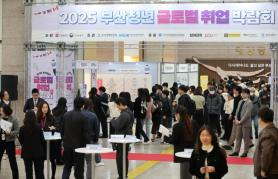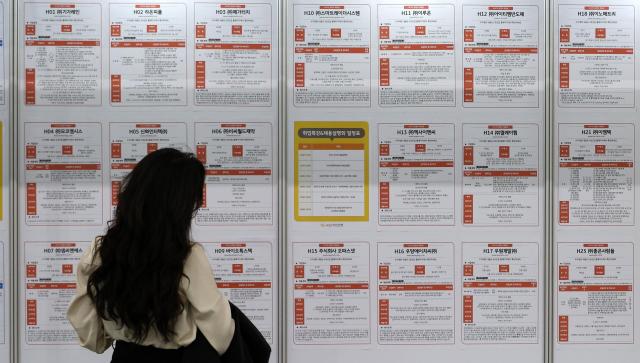
SEOUL, December 10 (AJP) - South Korea’s labor market continued to show an increasingly asymmetric pattern in November, with headline employment gains masking a deepening slump among young adults and a widening pool of NEET (not in education, employment or training) youth.
The number of people on payroll reached 29.05 million, up 225,000 from a year earlier, yet employment among those aged 15 to 29 fell by 177,000 over the same period, according to the Ministry of Data and Statistics on Wednesday.
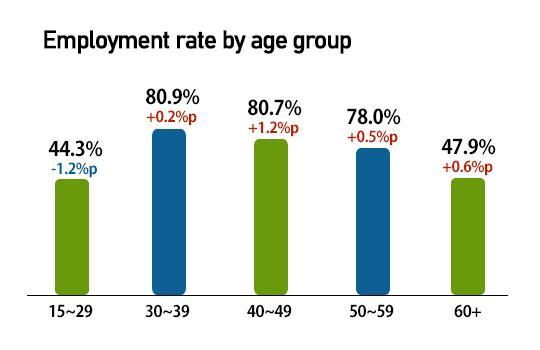
The youth employment rate dropped 1.2 percentage points to 44.3 percent, extending its decline to a 19th consecutive month.
Overall, job conditions improved modestly for older cohorts: employment rose 0.2 percentage point to 80.9 percent for those aged 30–39, 1.2 percentage points to 80.7 percent for those 40–49, and 0.5 percentage point to 78 percent for those 50–59.
Youth unemployment deteriorated, climbing 0.2 percentage point month-on-month to 5.5 percent, more than double the national jobless rate of 2.2 percent.
The divergence from older workers widened, as unemployment continued to fall among those aged 50 and above.
The “idled” population — who voluntarily dropped out of the labor force despite being physically able — further underscored the strain on the young. People aged 15–29 accounted for 16.3 percent in the idled group, second to the retired age of 60 and older who made up 45.1 percent. Those who gave up job hunt after futile job search numbered 353,000, up 18,000.
Employers cite a prolonged domestic slump across manufacturing, construction, and agriculture.
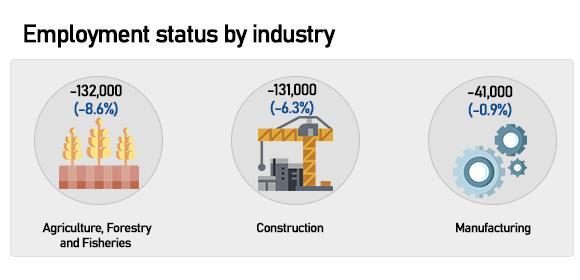
Construction posted the sharpest decline, shedding 131,000 workers from a year ago, reflecting a deep downturn spanning housing, civil engineering, and infrastructure.
Manufacturers cut 41,000 jobs — the smallest drop since October 2024 but still indicative of weak industrial momentum. Agriculture, forestry and fisheries lost 132,000 workers, or 8.6 percent, as employers increasingly turn to foreign labor to offset Korea’s high minimum wage.
Most of November’s job gains came from the services sector, heavily reliant on temporary and irregular hires. Employment in healthcare and welfare services rose 281,000, or 9.3 percent, buoyed by demographic-driven demand. Jobs in arts, sports, and leisure increased by 61,000, reflecting a rebound in consumer-facing spending even as the broader economy slows.

Copyright ⓒ Aju Press All rights reserved.