
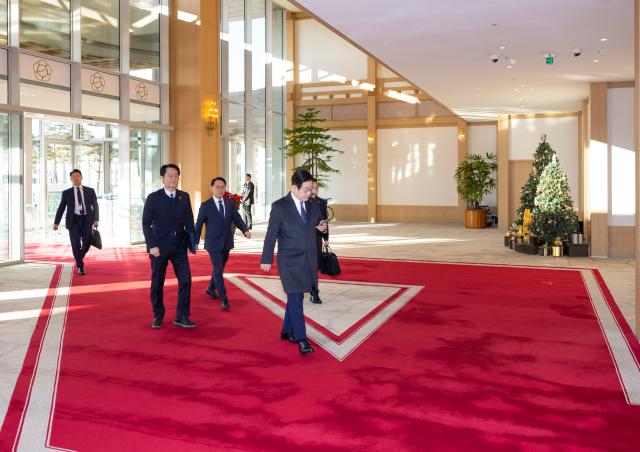
The official name of the president’s office will change from the Office of the President to Cheong Wa Dae on the same day. At midnight, the phoenix flag symbolizing the head of state will be lowered at the Yongsan presidential office to be raised at Cheong Wa Dae.
Former President Yoon Suk Yeol, who took office on May 10, 2022, relocated the presidential office to the former Ministry of National Defense compound in Yongsan and opened Cheong Wa Dae to the public as a tourist site.
The experiment with relocating a presidential office outside the traditional Cheong Wa Dae ended with his removal from office.
On Dec. 3, 2024, Yoon declared martial law, and on Apr. 4, 2025, the Constitutional Court upheld Yoon’s impeachment with a unanimous ruling by all eight justices. A snap election followed on Jun. 3. President Lee Jae Myung upon declared victor began term the following day.
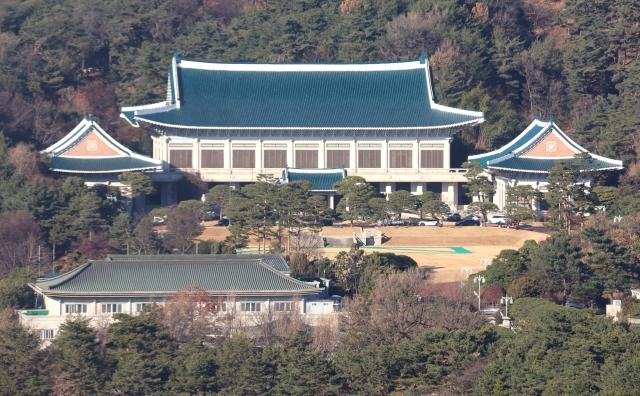
In Korean, Cheong Wa in Cheong Wa Dae means “blue tiles,” while dae means “building.”
The name comes from the main building’s distinctive blue-tiled roof. The complex was officially renamed Cheong Wa Dae on Dec. 30, 1960, during the administration of President Yun Po-sun.
According to the Cheong Wa Dae website, roughly 150,000 blue tiles were used in the roof, each individually fired. Their durability is said to exceed 100 years.
The current main building of Cheong Wa Dae, where the president conducts official duties and receives foreign guests, was completed on Sept. 4, 1991. Its construction followed mounting criticism that it was inappropriate for the president of the Republic of Korea to operate from the former office of the Japanese Governor-General, a remnant of the colonial era.
Designed in the style of a traditional royal palace, the building was intended to symbolize state authority and represent the Republic of Korea. The president’s main office is located on the second floor.
President Lee Jae Myung’s primary office is reportedly planned to be located on the third floor of Yeomin Building 1, part of the Cheong Wa Dae office complex where senior presidential aides work. According to a presidential aide, the arrangement is intended to minimize movement between the president and top staff to enhance communication efficiency.
Historically, the site of Cheong Wa Dae has served multiple roles. During the Japanese colonial period, it housed the residence of the Governor-General. Under the U.S. military government, Lt. Gen. John R. Hodge used the residence as his official quarters. South Korea’s first president, Rhee Syngman, later used the same building as both his office and residence.
Earlier still, during the Goryeo Dynasty (918–1392), the site contained a royal villa, and during the Joseon Dynasty (1392–1897), it formed part of the rear garden of Gyeongbokgung Palace.
Cheong Wa Dae has also hosted moments of modern diplomatic symbolism. In July 1993, during an official visit to South Korea, then-U.S. President Bill Clinton jogged for 15 minutes and 20 seconds along the Nokjiwon trail with then-President Kim Young-sam.
Copyright ⓒ Aju Press All rights reserved.
