
LAS VEGAS, January 06 (AJP) -South Korea's auto conglomerate Hyundai Motor Group will start training its self-developed fleet of robots for full deployment in U.S. assembly lines from 2030, according to its vision on “AI robotics” unveiled at the CES.
At a CES 2026 media day held at the Mandalay Bay Convention Center in Las Vegas, the group presented its overarching theme, “AI Robotics, From the Lab to Life,” signaling a shift beyond hardware- and mobility-focused robotics toward what it calls human-centered AI robotics.
Hyundai outlined three strategic priorities: expanding human–robot collaboration beginning on factory floors; building an AI robotics ecosystem by integrating the technological capabilities of its group affiliates; and strengthening partnerships with leading global AI companies.
The group said it aims to become a leader in “physical AI” by leveraging its broad value chain and product portfolio.
To support that push, Hyundai said it plans to establish a Hyundai Motor Group Physical AI Application Center in South Korea, along with a robot finished-product manufacturing and foundry plant based on customized robot technologies developed through physical AI.
A Hyundai Motor Group official said the company’s focus is “not what technology can do, but what humanity can achieve through technology,” adding that Hyundai will demonstrate “true cooperation” between humans and robots in line with its corporate philosophy of “progress for humanity.”
Hyundai said Atlas, showcased at CES, is expected to play a pivotal role in turning human–robot collaboration into reality across manufacturing and industrial sites. The humanoid robot combines Hyundai’s manufacturing data and production expertise with research and development from Boston Dynamics.
The group also introduced a next-generation electric Atlas development model, which adds autonomous learning capabilities and enhanced flexibility. Hyundai said the upgraded model can be applied across diverse work environments, improving efficiency in real-world manufacturing settings.
Hyundai identified humanoid robots as the largest future market within physical AI and set a goal of mass-producing the next-generation electric Atlas model to enable large-scale deployment at industrial sites.
Hyundai plans to deploy Atlas at production bases, including Hyundai Motor Group Metaplant America (HMGMA), with a phased rollout following process-by-process verification.
From 2028, the robot will first be applied to tasks with clearly verified safety and quality benefits, such as sequencing work for parts classification. From 2030, Hyundai plans to expand Atlas’s role to parts assembly.
Hyundai also said it will open a Robot Metaplant Application Center (RMAC) in the United States this year. Atlas models trained at RMAC are expected to contribute to worker safety and product quality improvements at HMGMA.
Hyundai said it has maintained a strategic partnership with Nvidia since January last year and plans to use advanced AI infrastructure and platforms to accelerate innovation and improve development efficiency.
Within the group, Hyundai Motor and Kia will provide manufacturing infrastructure, process control systems and production data. Hyundai Mobis will develop precision actuators, while Hyundai Glovis will optimize logistics and supply-chain flows.
Hyundai Mobis also plans to supply actuators for Atlas in partnership with Boston Dynamics, marking what the group described as a full-scale entry into the global robot components market.
Hyundai said it aims to build a system capable of producing 30,000 robots annually by 2028, accelerating mass production and positioning Atlas as an industrial humanoid robot for large-scale deployment across industrial and commercial markets.
Over the longer term, the group plans to use data accumulated through Atlas to enhance learning and usability, expand beyond automotive manufacturing into other industrial fields, and eventually enter the B2C market by developing a general-purpose humanoid robot.
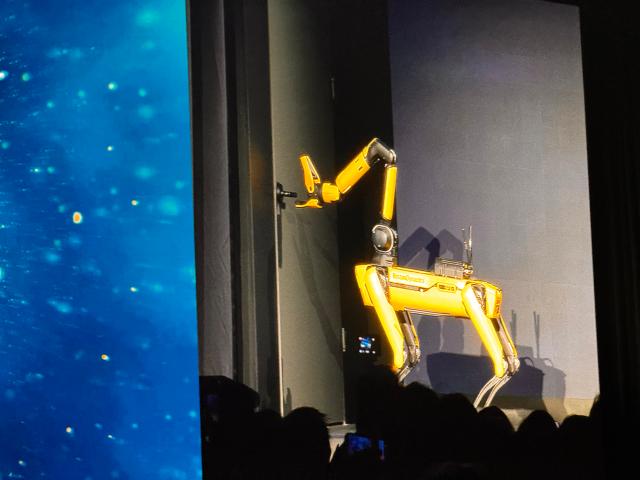
Hyundai said its existing robots Spot and Stretch have already proven their usefulness at companies including Intel, Michelin and DHL, and are expected to expand into sectors such as construction, logistics, facility management and energy.
Separately, the group announced plans to invest $26 billion in the United States over four years starting in 2025, expanding cooperation with leading U.S. companies in future technologies including robotics, AI and autonomous driving. Hyundai said it expects broader economic cooperation between South Korea and the United States and plans to widen business opportunities to strengthen competitiveness across mobility and future industries.
Copyright ⓒ Aju Press All rights reserved.
