

SEOUL, January 12, 2026 (AJP) — South Korea has a new dessert obsession, and it doesn’t crumble quietly.
The Dubai Chewy Cookie, locally nicknamed dujjonku, is selling quite literally like hot cake — except hotter, thicker and far more Instagrammable. What began as a café novelty has now spilled across menus nationwide, with sushi joints and sandwich shops alike slipping the chewy chocolate slab into delivery apps, as if dessert were now a compulsory add-on to every meal.
Search interest reflects the sugar rush. Google Trends data show queries for “dujjonku” surging over the past 90 days, with some regions hitting a peak index of 100 in early January — a level usually reserved for election nights or celebrity scandals.
For the uninitiated: yes, the dessert traces its name to Dubai. But what Korea is eating today is less a faithful import than a full-scale reinterpretation.
The craze took off last September after IVE’s Jang Won-young posted about the dessert on social media. As often happens in Korea’s tightly wired influencer ecosystem, one post was enough. Others followed. Cafés rushed to recreate it. Within weeks, the chewy cookie was no longer exotic — it was everywhere.
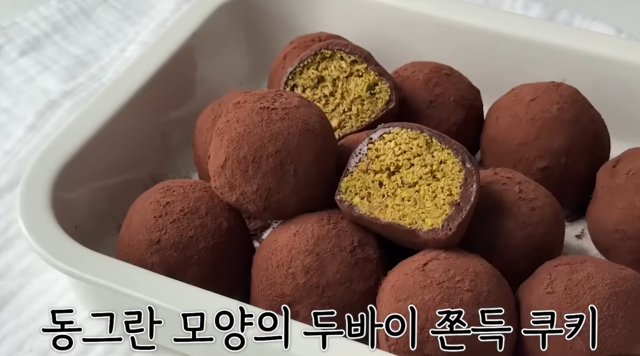
The dessert borrows from Middle Eastern sweets, combining crisp kadaif pastry, pistachio cream and cocoa powder. But the Korean version leans into exaggeration. Wrapped in a marshmallow-like chew, the cookie favors thickness over delicacy, volume over restraint.
If the original “Dubai chocolate” was elegant, the chewy cookie is maximalist.
Its appeal is as visual as it is edible. The dramatic cross-section, the audible crack, the slow stretch — all play perfectly to short-form video platforms, where desserts are judged less by taste than by how spectacularly they break apart on camera.
“Dessert trends in Korea consistently favor abundance,” said food critic Lee Yong-jae. “Visual overwhelmingness often matters more than balance or subtlety of flavor.”
Food columnist Jeong Dong-hyun points to Korea’s unusually flexible food culture.
“Unlike Europe, Korea does not cling strongly to the ‘original form’ of food,” he said. “That allows dishes to be endlessly reinterpreted to suit local tastes — and entirely new foods to be created.”
The sugar rush is translating into real money.
At Paris Baguette’s Louvre flagship near Gwanghwamun, staff say the chewy cookie has climbed rapidly into top-seller territory. “We sell around 4,000 to 5,000 units a day,” said Sandy Lim, a café employee in her 50s, noting that foreign customers account for a larger share on weekends.
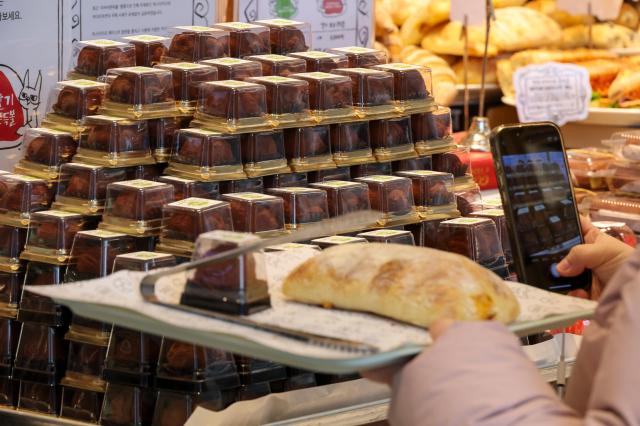
But sweetness has a price.
The Dubai Chewy Cookie relies heavily on imported ingredients, particularly pistachios and specialty pastry components, whose costs fluctuate with global supply conditions. As these ingredients spread across café menus, their price tags are quietly filtering into everyday food costs.
According to the Ministry of Data and Statistics, food and dining-out prices have been rising faster than overall inflation in recent months — a reminder that even viral desserts can leave a macroeconomic aftertaste.
In that sense, dujjonku offers a bite-sized lesson in demand-driven inflation: when trends go viral, costs don’t stay contained.
At 7,000 to 8,000 won per piece, the chewy cookie now costs more than a burger set — or a modest weekday lunch.
Sweet, stretchy, and a little expensive, Korea’s favorite new dessert may be indulgent — but it is also, quietly, inflationary.

Copyright ⓒ Aju Press All rights reserved.
