The result was especially striking given that the Seollal, or Lunar New Year, cut working days by three compared with the same month last year, a factor that typically weighs on shipment volumes. On a daily average basis, exports soared 49.3 percent to $3.55 billion, breaching the $3 billion threshold for the first time.
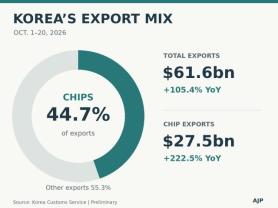
Semiconductors powered the rally. Chip exports rocketed 160.8 percent to $25.16 billion, an all-time monthly record fueled by surging demand for artificial intelligence infrastructure and a sharp run-up in memory prices. The benchmark price for 8GB DDR4, a standard PC memory chip, leapt to $13.00 from $1.35 a year ago, while 16GB DDR5 climbed to $30.00 from $3.79. 128GB NAND flash memory prices jumped to $12.67 from $2.29.
Semiconductor shipments have now topped $20 billion for three consecutive months, climbing from $15.7 billion in October through $20.8 billion in December to $25.2 billion in February, extending a streak of nine straight months of record exports stretching back to June last year.
Computer exports rose 221.6 percent to $2.56 billion on robust solid-state drive demand, while wireless communication devices gained 12.7 percent to $1.47 billion, buoyed by new handset launches.
Shipbuilding exports advanced 41.2 percent to $2.2 billion and bio-health shipments edged up 7.1 percent to $1.31 billion.
However, the holiday drag hit manufacturing-heavy sectors. Automobile exports fell 20.8 percent to $4.81 billion and auto parts declined 22.4 percent to $1.45 billion as production volumes shrank. General machinery slid 16.3 percent, petrochemicals dropped 15.4 percent amid a global supply glut, and petroleum products dipped 3.9 percent as weak crude prices offset higher shipment volumes.
By destination, exports to the United States climbed 29.9 percent to a February record of $12.85 billion, led by chips and computers. Shipments to China rose 34.1 percent to $12.75 billion, driven by a 141 percent spike in semiconductor exports. Exports to the Association of Southeast Asian Nations surged 30.4 percent to $12.47 billion, also a February record, while European Union-bound shipments gained 10.3 percent to $5.6 billion.
Imports rose 7.5 percent to $51.94 billion, producing a trade surplus of $15.51 billion — the largest monthly surplus on record and an increase of $11.55 billion from a year earlier. The trade balance has now stayed in the black for 13 consecutive months.
The ministry cautioned that external uncertainties remain elevated, citing heightened geopolitical tensions in the Middle East and U.S. tariff policies as persistent risks.
Minister of Trade, Industry and Resources Kim Jung-kwan said the government would "closely monitor export and import trends to minimize the impact of geopolitical risks originating from the Middle East" and maintain close communication with Washington to safeguard the conditions secured under a bilateral tariff agreement.
Kim added that Seoul would push for swift parliamentary passage of a special law on U.S.-bound investment and pursue a cross-ministry export expansion plan unveiled last month, aiming to propel South Korea into the ranks of the world's top five exporters this year.

Copyright ⓒ Aju Press All rights reserved.