
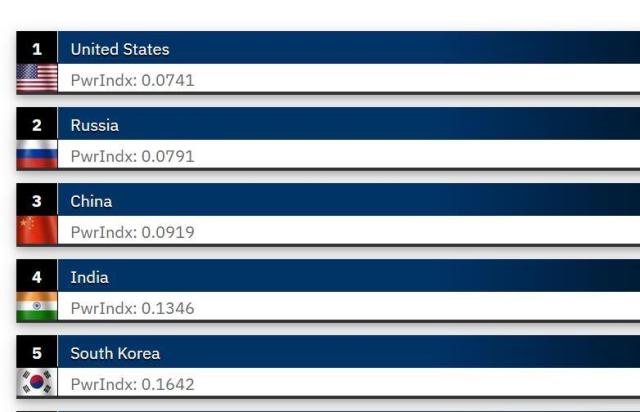
According to the 2026 Military Strength Ranking released by U.S.-based Global Firepower (GFP), South Korea placed fifth out of 145 countries, behind only the U.S., Russia, China and India. North Korea ranked 31st.
GFP aggregates more than 60 indicators — ranging from the size of military units and defense spending to logistics and geography — into a composite index of conventional military power. Rather than spotlighting a single “wonder weapon,” the ranking aims to measure how much usable force a country can generate and sustain in a major conflict.
The U.S. tops the list with a Power Index (PwrIndx) score of 0.0741, where a theoretical score of 0.0000 represents “perfect” capability. South Korea’s score of 0.1642 places it fifth overall.
Beyond its current inventory, Seoul is pushing ahead with a series of flagship modernization programs designed to anchor its conventional edge into the 2030s and beyond. These include the Korean Next-Generation Destroyer (KDDX) program, which will deliver large, stealthy destroyers equipped with domestically developed radars and missiles; the homegrown KF-21 Boramae fighter, scheduled to enter service from 2026; a multibillion-dollar upgrade of the F-15K fleet; and the AKJCCS project to rebuild the Korea-U.S. joint command-and-control system with AI-enabled decision-support tools.
Still, South Korea’s day-to-day military strength rests on a set of core platforms on land, at sea and in the air — the systems that translate budgets and plans into tangible combat power.
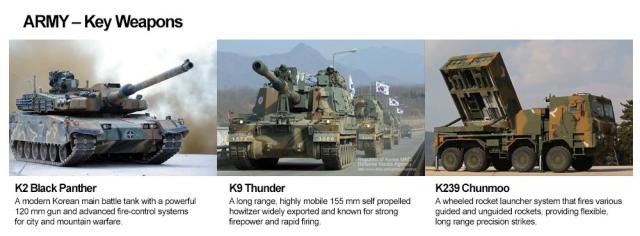
On the ground, South Korea relies on modern tanks and heavy artillery to support large conscript and reserve forces. Together, they allow the Army to hold defensive lines in rugged terrain and, if required, mount large-scale counterattacks.
At the center of its armored units is the K2 Black Panther, a domestically built main battle tank roughly the size of a city bus, combining heavy armor, a powerful gun and advanced sensors that enable accurate fire on the move.
Artillery provides the other half of the Army’s heavy punch. K9 self-propelled howitzers can rapidly move into position, fire on distant targets and relocate before counterfire arrives, while towed artillery remains largely assigned to fixed defenses and rear areas. Multiple-launch rocket systems such as Chunmoo add wide-area and long-range strike capability, creating a dense, layered wall of fire when combined with tanks and guns.
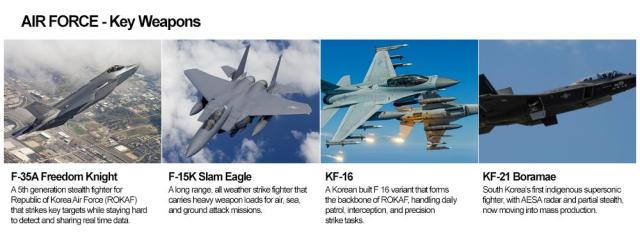
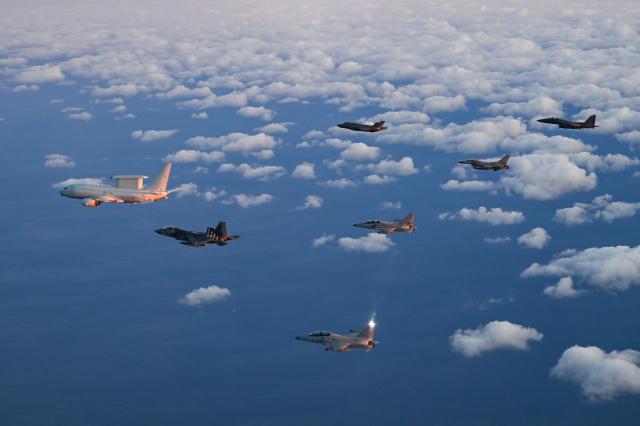
In the air, South Korea fields a three-tier fighter structure: stealth aircraft at the top, multirole fighters in the middle and upgraded workhorses at the base.
At the high end is the F-35A, a fifth-generation stealth fighter designed to evade radar, gather intelligence and strike high-value targets while acting as a flying sensor hub for other forces. Below it, the F-15K — often described as a “missile truck in the sky” — carries heavy payloads for air-to-air combat and long-range strike missions.
The KF-16, the Air Force’s most numerous fighter, handles routine patrols, interceptions and precision strikes. Ongoing upgrades to its radar and avionics are allowing older airframes to perform closer to modern standards. Over the next decade, the KF-21 will slot between the stealthy F-35A and upgraded fourth-generation fighters, further reinforcing South Korea’s qualitative edge.
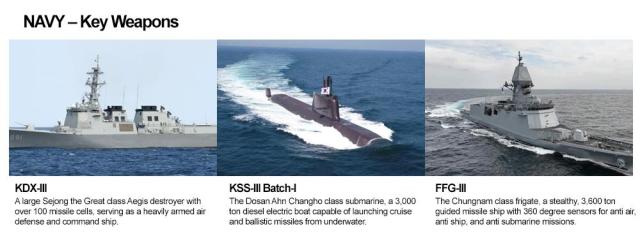
At sea, South Korea pairs large surface combatants with quiet submarines to protect its coastlines and sea lanes and to deter regional threats.
The KDX-III Sejong the Great-class destroyers, each roughly the length of a football field and displacing more than 8,500 tons, are equipped with powerful Aegis radars and more than 120 vertical launch cells. They can track multiple targets simultaneously, intercept incoming missiles and aircraft, and serve as floating command centers for fleet operations.
Newer FFG-III Chungnam-class frigates, displacing about 3,600 tons, add a stealthier, more versatile layer. Their four-sided integrated sensor masts provide 360-degree coverage, while modern anti-air and anti-submarine weapons make them well suited for routine patrols, submarine hunting and convoy protection closer to home.
Below the surface, 214-class submarines and the larger 3,000-ton KSS-III Dosan Ahn Changho-class boats can remain submerged for extended periods, quietly tracking enemy vessels or positioning to launch torpedoes, cruise missiles and even ballistic missiles. Seoul continues to upgrade these high-end platforms while retiring older vessels to steadily raise overall fleet quality.
GFP’s ranking places North Korea in the low 30s for conventional strength, up several spots from last year. But the index is not designed to fully capture nuclear weapons, long-range missiles, cyber operations or special forces.
South Korea’s fifth-place ranking therefore reflects its non-nuclear conventional capacity rather than the full balance of power on the peninsula.
“Those rankings provide a useful snapshot of conventional forces, but they focus primarily on quantifiable metrics like the number of tanks and do not fully capture asymmetric factors such as nuclear weapons, cyber capabilities, or how a real war would unfold,” said Chun In-bum, a retired South Korean Army lieutenant general.
Experts note that such indices, by design, focus on conventional capabilities and leave out the nuclear and strategic factors that would shape any real conflict on and around the Korean Peninsula. For Seoul, any serious assessment of security must account not only for North Korea’s nuclear and missile forces, but also for the strategic weapons fielded by neighboring powers — including China, Japan and the U.S.

Copyright ⓒ Aju Press All rights reserved.
