
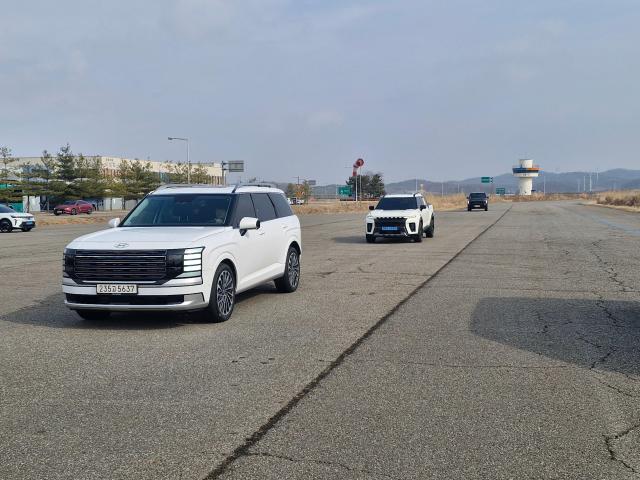
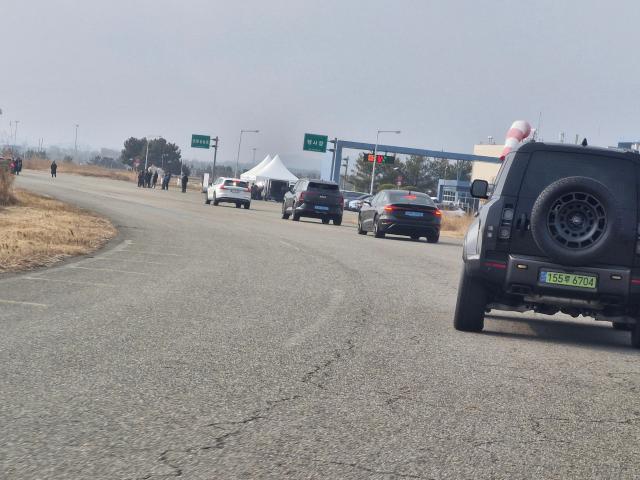
In the first round, 18 vehicles from 10 domestic and overseas brands advanced to the final list.
After holding a regular general meeting that morning, members of the Korea Automobile Journalists Association moved straight to the track for the road tests. The evaluation ran across four courses: a high-speed circuit, a steering-handling course, an automatic emergency braking test and a special durability road. About 40 reporters split into two groups and rotated through the vehicles for side-by-side comparisons.
The first vehicle tested by a reporter on site was Kia’s PV5. On the special durability road, which features rough pavement, the focus was on suspension performance and body response. Though it is a relatively compact boxy vehicle, it absorbed bumps steadily, and cabin noise was not pronounced.
Next was Hyundai Motor’s Ioniq 9. Its stable driving, supported by the low center of gravity typical of electric vehicles, stood out. One reporter riding along said, “An expensive car delivers what you pay for.”
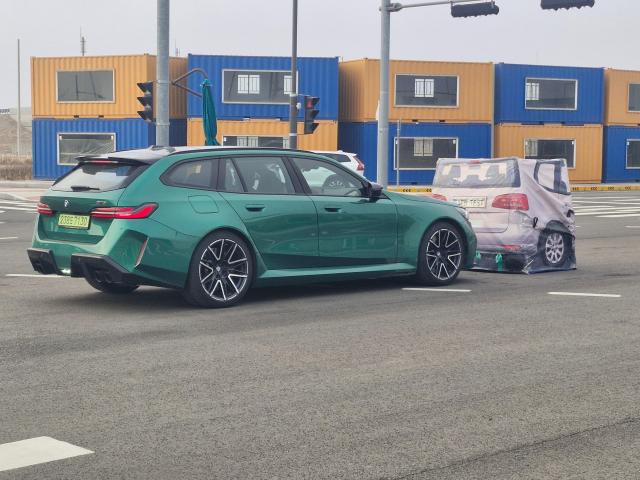
Steering performance tests followed, with vehicles pushed through sharp turns to check handling. Despite a short course with consecutive curves, the finalists showed stable performance. High-performance models such as the Mercedes-AMG GT, Audi RS e-tron GT and Hyundai Ioniq 6 N were especially notable.
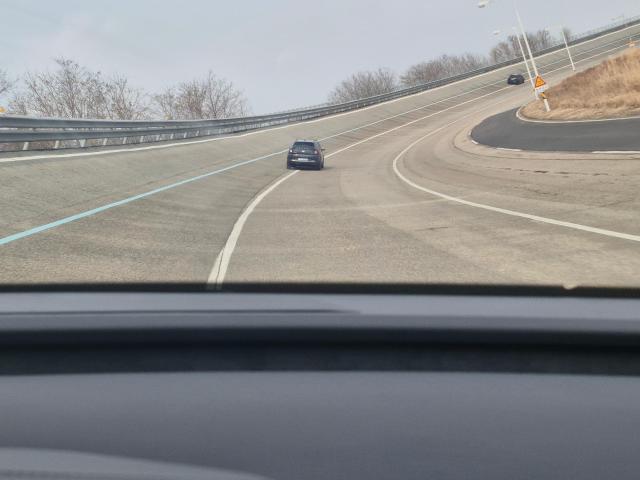
The highlight for many was the high-speed course. On a banked track, drivers increased speed to as much as 200 kph to assess high-speed capability. The BMW Touring M5, with its distinctive green exterior, showed quick responses backed by a powerful engine. The Land Rover All New Defender Octa maintained a heavy, planted feel at speed.
* This article has been translated by AI.
Copyright ⓒ Aju Press All rights reserved.