
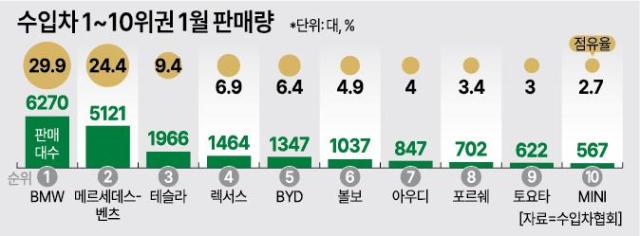
South Korea’s imported-car market is posting strong growth early this year despite headwinds such as a weak won and the usual seasonal slowdown. The long-dominant BMW-Mercedes-Benz “two-top” structure — which at one point neared a 70% market share — is weakening as newer challengers close in, intensifying the fight for positions No. 3 through No. 5.
The Korea Automobile Importers & Distributors Association said Monday that new registrations of imported cars totaled 20,960 in January, up 37.6% from 15,229 a year earlier. January is typically considered an off-season because year-end promotions end, discounts shrink and new-model lineups can be thin. Even so, January sales were the highest for the month in five years, since January 2022 (17,361).
Competition is tightening. BMW and Mercedes-Benz, which together accounted for about 70% of the market last year, saw their combined share shrink to the 50% range this year, while EV brands such as Tesla and BYD newly entered the top five.
BMW ranked No. 1 in January with 6,270 new registrations, up 5.2% from 5,960 a year earlier. Gasoline-powered models led the results, including the 5 Series (1,951), X3 (689), X5 (602) and 3 Series (568). BMW’s market share, however, fell about 10 percentage points to 29.9% from 39.1% a year earlier.
Mercedes-Benz was No. 2 with 5,121 vehicles sold, up 35.1% from 3,790 a year earlier, driven by core models including the E200 (1,207) and E300 4MATIC (782).
Tesla placed third with 1,966 vehicles sold. The Model Y (1,134) and Model X (160) helped lift its market share to 9.4% from 0.03% a year earlier. Tesla has been pushing to expand share this year with aggressive pricing, cutting prices for models such as the Model Y and Model 3 by 3 million to more than 5 million won.
The race from fourth to sixth is also close. Lexus ranked fourth with 1,464 vehicles, followed by BYD in fifth with 1,347 — just 117 behind Lexus — and Volvo in sixth with 1,037. BYD, citing strong price competitiveness and a rapid new-model rollout, reached fifth place with a 6.4% share just one year after entering the South Korean market.
An official at an imported-car company said “three factors” are reshaping the market: value-focused competition from Chinese-made EVs, the mainstreaming of eco-friendly vehicles and widening consumer polarization. The official said competition to hold a top-five position will intensify further, with brand rankings shifting on differences of only about 100 to 200 vehicles.
* This article has been translated by AI.
Copyright ⓒ Aju Press All rights reserved.