SEOUL, February 20 (AJP) - Brazil is looking beyond "traditional trade" through the Feb. 22–24 visit to South Korea, tapping fields from K-beauty to biosimilars, artificial intelligence and space cooperation in pursuit of "productive integration," its ambassador to Seoul said.
"The main issue is reinvigorating a relationship that has evolved on just 'okay' in the past several years and is in need of a big jump," Ambassador Marcia Donner Abreu told AJP in an exclusive interview Thursday, ahead of President Luiz Inácio Lula da Silva's first state visit to Korea in 21 years.
Mononymously known as Lula, the 80-year-old statesman returned to office in 2023 for a third, nonconsecutive term after governing Brazil from 2003 to 2010. His last exclusive bilateral visit to Seoul was in 2005 at the invitation of the late President Roh Moo-hyun.
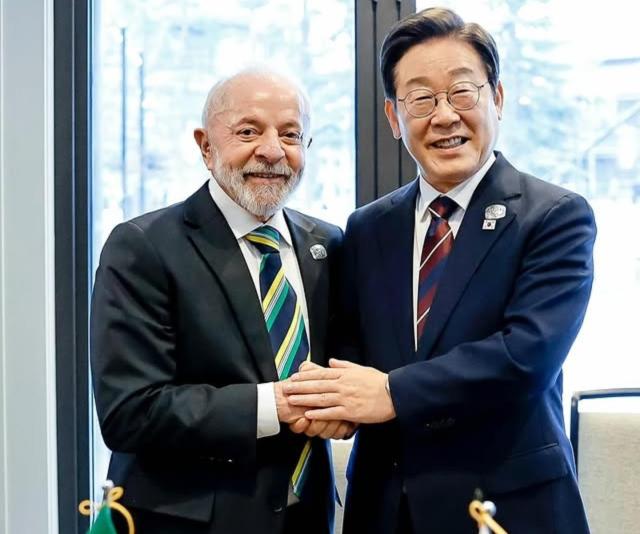
South Korean President Lee Jae Myung and Lula met for the first time on Jun. 17 last year, in Kananaskis, Canada, on the sidelines of the Group of Seven (G7) summit.
What could have been a routine diplomatic meeting created an instant rapport between the two men who had walked strikingly similar paths as underage factory boys with permanent work injuries, and as politicians who were continuously put under a barrage of investigations and legal battles, according to the envoy in Seoul.
"Chemistry exists; it is excellent," she said. "Both come from very poor families. Both had work-related injuries that marked them. President Lee as a lawyer, President Lula as a union leader — both are presidents."
Such shared experiences, she emphasized, are expected to help turn political dialogue into tangible outcomes in the upcoming visit.
"The personal relationship always helps. It helps the dialogue evolve into positive terrain."
From trade to "productive integration"
For Abreu, the upcoming visit marks an attempt to move bilateral ties beyond transactions toward joint value creation.
"My president has just been in India, and we see significant potential in Asia," she said. "The same applies to Korea. There is strong potential to increase trade — but not only trade. Trade and productive integration. This includes value chains, investments, a number of things."
While automobiles and electronics remain the backbone of bilateral commerce, a new three-year plan of action focuses on complex, high-growth industries.
Roughly 15 agreements are expected in biopharmaceuticals, centering on biosimilars and industrial engagement. In defense and aviation, Brazil hopes to build on the C-390 transport aircraft deal through structured partnerships for sourcing components and establishing joint production lines.
"In space, we have a very good chance to make something between your space agenda and the Brazilian aerospace agency," Abreu said.
Digital industries and artificial intelligence will also feature prominently, with plans for a structured bilateral dialogue.
K-beauty and the Amazon connection
Cosmetics is emerging as one of the most dynamic areas of cooperation.
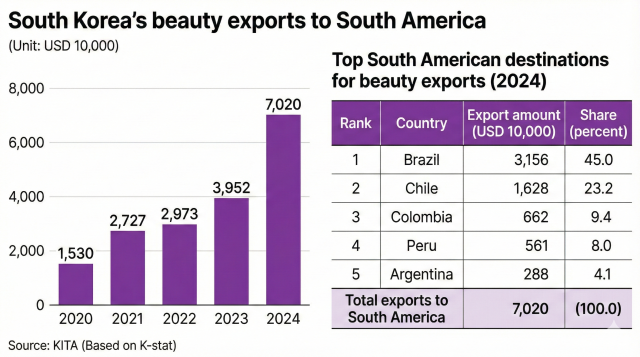
According to the Korea International Trade Association, Korean cosmetics exports to Latin America expanded from about $100 million in 2020 to roughly $400 million in 2024, growing more than 40 percent annually. Brazil, the region's largest cosmetics market, has become a major battleground for global brands, with Korean exports there more than doubling in the past three years.
Demand has surged for skincare and haircare products, while Korean brands have expanded their presence in pharmacy-based derma-cosmetic channels.
"The extraordinary success of Korean cosmetics is based on a formula that combines high technology," Abreu said. "But we also have this treasury of Amazonia with many ingredients. Using natural ingredients from different parts of the world could be very valuable."
She sees scope for joint development linking Korean formulation expertise with Brazil's biodiversity.
Beyond a resource supplier
Brazil is also seeking to reposition itself in global supply chains, particularly in critical minerals.
Rather than remaining a provider of lithium, niobium and other raw materials, Brasília wants to cooperate with Korean firms on downstream processing and manufacturing.
"We don't want to just buy things and sell them," Abreu said. "We want local processing and refining, leveraging Korean competitiveness and technology."
She described advanced materials and "creative minerals" as key to future cooperation in batteries, semiconductors and renewable energy.
No FTA, but a flexible framework
Despite deepening ties, Brazil is not pursuing a conventional bilateral free trade agreement with Korea, citing institutional constraints within Mercosur.
"The FTA is not a bilateral negotiation — it's a Mercosur negotiation," she said. "It's not something Brazilian authorities can simply decide."
Instead, both sides are working on a "trade and productive integration arrangement," designed to enable faster industrial cooperation without lengthy ratification procedures.
"We believe this arrangement can pave the way for further integration, including future regional negotiations," she said.
A turning point after two decades
Lula's return to Seoul after more than two decades reflects Brazil's broader push to strengthen ties with Asian partners and diversify its economic diplomacy.
During the Feb. 22–24 visit, the two leaders are expected to discuss trade and investment, supply chains, energy, technology, space cooperation, and cultural exchange.
For Brasília, the objective is to transform a largely transactional relationship into a long-term strategic partnership based on joint production and innovation.
"This is about building something together," Abreu said. "Not just exchanging goods, but creating value."
Copyright ⓒ Aju Press All rights reserved.