
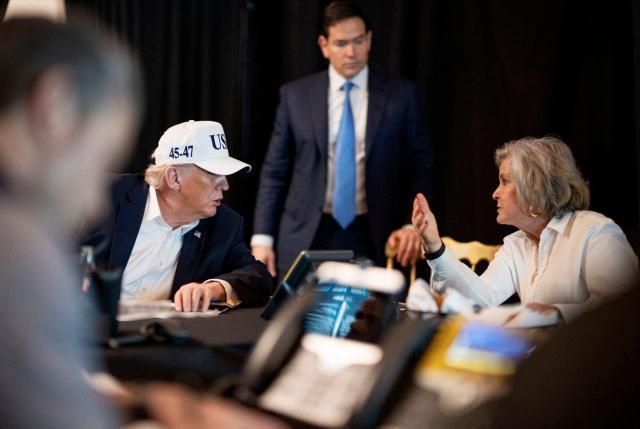
The National Security Office reviewed the situation on the ground, assessed impacts on national security and the economy, and prioritized the safety of Korean nationals in the region.
President Lee Jae Myung was briefed and directed officials to place citizen protection first while closely monitoring developments and preparing for a prolonged scenario.
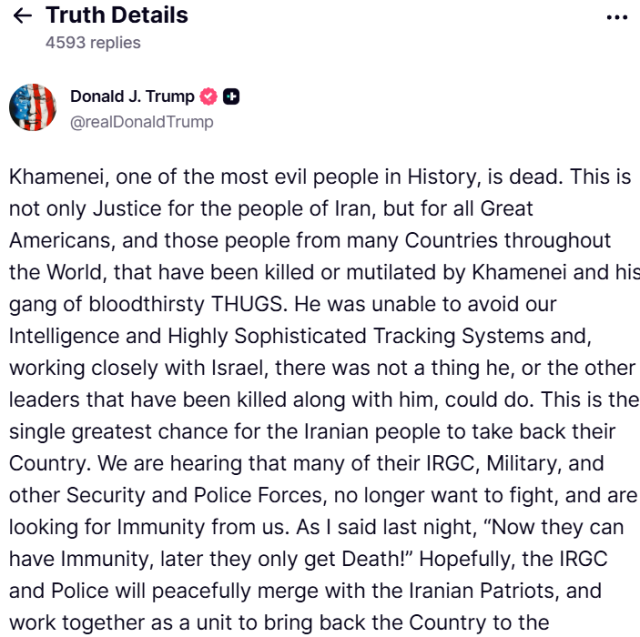
The urgency reflects the scale of events. U.S. President Donald Trump declared on social media that Iran’s Supreme Leader Ayatollah Ali Khamenei was dead, framing it as “the single greatest chance” for Iranians to reclaim their country and signaling that joint U.S.-Israeli airstrikes would continue “as long as necessary.”
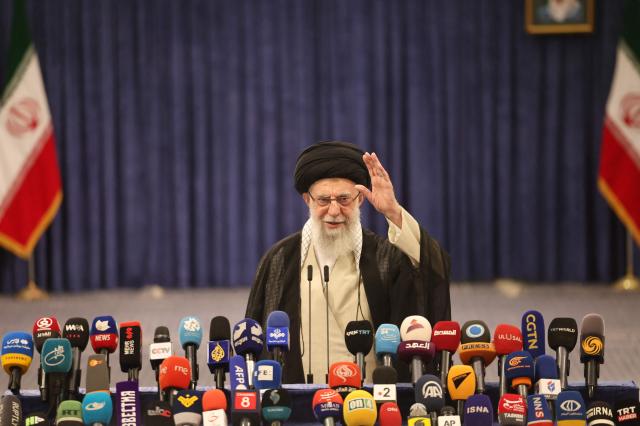
Israel has indicated Khamenei was killed, though Tehran has not issued definitive confirmation. Regardless of formal verification, the claim alone marks a dramatic escalation: the potential removal of the Islamic Republic’s top authority introduces succession uncertainty, raises the likelihood of retaliatory escalation, and shifts the conflict from deterrence to regime-level confrontation.
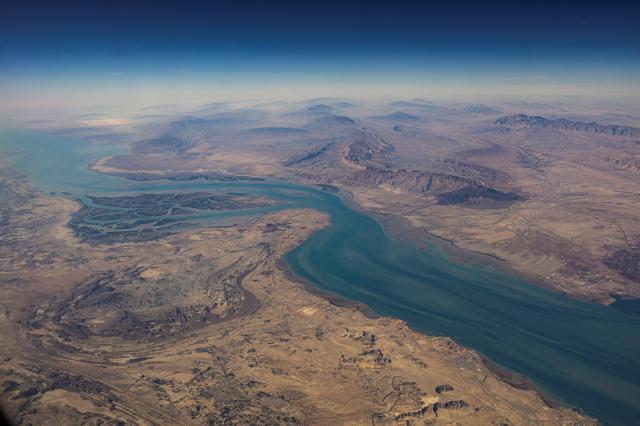
Iran has already responded with missile and drone strikes against Israel and U.S. military bases in the region. Reports of attempts to restrict shipping through the Strait of Hormuz — a chokepoint for roughly 20 to 30 percent of global seaborne crude — have injected immediate volatility into energy markets. For South Korea, heavily dependent on imported oil and global trade flows, that channel represents the most direct economic exposure.
Security repercussions on the Korean Peninsula
Yet beyond oil prices and currency swings, the crisis carries a deeper strategic resonance for the Korean Peninsula.
The U.S. decision to escalate militarily against Iran — including the reported targeting of its supreme leader — signals that Washington is willing to employ decisive force when it judges long-term threats to outweigh immediate risks. While the Iranian case differs significantly from North Korea’s nuclear status and deterrence structure, the broader message is unmistakable: the United States retains both the capability and the political will to act preventively under certain conditions.
For Pyongyang, led by nuclear-armed and nuclear-ambitious leader Kim Jong Un, the episode offers competing lessons. On one hand, it may reinforce the regime’s long-held conviction that nuclear weapons are the ultimate guarantee of survival — a shield against external intervention. On the other, it underscores that strategic isolation, internal repression, and overt missile or nuclear brinkmanship do not remove the possibility of calibrated military action by adversaries.
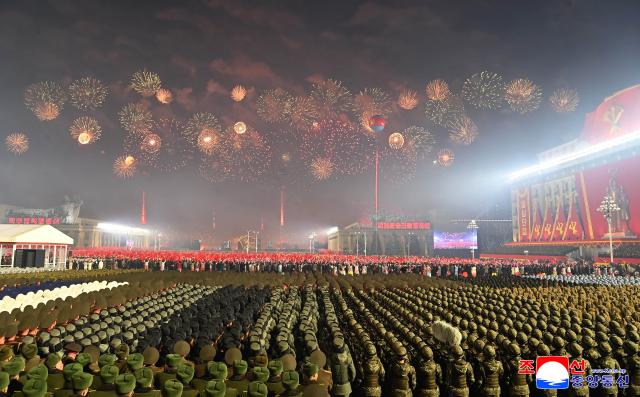
North Korea’s deterrence posture is structurally different from Iran’s. Pyongyang already possesses an operational nuclear arsenal and tested delivery systems, creating a far more immediate retaliatory risk calculus. That mutual deterrence raises the threshold for direct military confrontation. But it does not eliminate pressure, especially if the international community judges that proliferation or escalation is crossing unacceptable lines.
For Seoul, the priority is twofold. First, to ensure that alliance coordination with Washington remains tight and predictable, minimizing the risk of misinterpretation in Pyongyang. Second, to maintain robust crisis communication mechanisms that reduce the possibility of accidental escalation in a tense regional environment.
South Korea’s security planners worry that events in the Middle East can shape strategic psychology in East Asia. A U.S. demonstration of force elsewhere can alter threat perceptions, alliance expectations, and the signaling environment on the Korean Peninsula. In such moments, clarity and restraint matter as much as capability.
At the same time, Seoul policymakers would have to closely watch the economic dimension of the shock. Rising oil prices, shipping disruptions, and renewed currency volatility could intersect with security anxieties, amplifying uncertainty. Korea’s recent equity surge and relative currency stabilization were signs of improving sentiment; a prolonged Middle East conflict could challenge that stability.
Copyright ⓒ Aju Press All rights reserved.
