
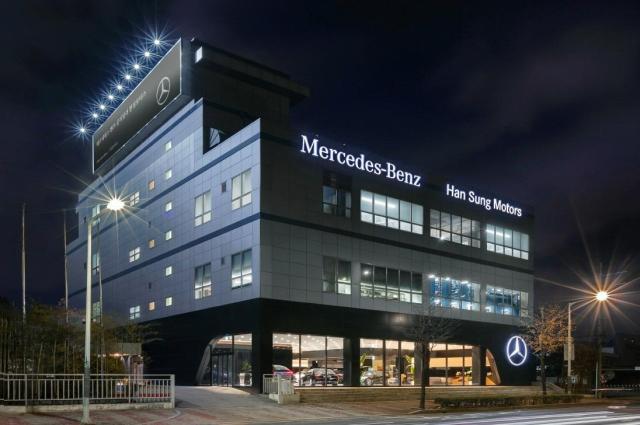
South Korea’s Fair Trade Commission ordered Mercedes-Benz to take corrective steps and pay a penalty surcharge of 11.339 billion won, accusing the automaker of deliberately omitting and concealing information about electric-vehicle battery cells. Mercedes-Benz Korea denied wrongdoing and said it is considering an administrative lawsuit to contest the decision.
On the 10th, the commission said Mercedes-Benz installed Farasis battery cells in many EV models, including the EQE and EQS, but failed to disclose that fact. Instead, it allegedly created “vehicle sales guidelines” that dealers used in marketing, making it appear that all of its EVs used cells from CATL, described as the world’s No. 1 battery cell maker. The FTC said that amounted to deceiving consumers and imposed the corrective order and the 11.339 billion won penalty surcharge.
Separately, the FTC said it found grounds to believe Mercedes-Benz Korea and the German headquarters were directly or indirectly involved in the violations and decided further investigation was needed. It referred the case to prosecutors.
Under current law, penalty surcharges for unfair trade practices can reach up to 4% of related sales. The FTC said its order against Mercedes-Benz applied the maximum 4% rate.
According to the FTC, Mercedes-Benz instructed dealers to promote sales by highlighting CATL’s strengths without mentioning Farasis. But the FTC said that, contrary to the guidance, Farasis cells were installed in four of six EQE models and one of seven EQS models that Mercedes-Benz released.
Information on the battery cell manufacturer is a key factor for consumers choosing an EV, the FTC said. It said dealers, relying on the company’s sales guidance, marketed and sold vehicles as equipped with CATL batteries.
The FTC said about 3,000 EVs with Farasis cells were sold from June 8, 2023, when Mercedes-Benz notified dealers of the sales guidance, until Aug. 12, 2024, when disclosure of battery cell makers began after an apartment underground parking garage fire in Incheon’s Cheongna district on Aug. 1, 2024. The FTC put sales at about 281 billion won.
Mercedes-Benz Korea said it did not violate the law and called the FTC’s conclusion unfair. In a statement, the company said it respects the FTC’s decision but disagrees with its judgment and will present its position through legal procedures, including an administrative lawsuit.
“We operate our business with a high level of corporate ethics and responsibility and in compliance with laws and regulations,” the company said, adding that it has cooperated faithfully with authorities since the early stages of the investigation and that compliance is a core part of its corporate culture.
It also said it has always provided correct and accurate information to the media and customers and will continue to state its position through legal procedures, including filing an administrative lawsuit.
* This article has been translated by AI.
Copyright ⓒ Aju Press All rights reserved.