
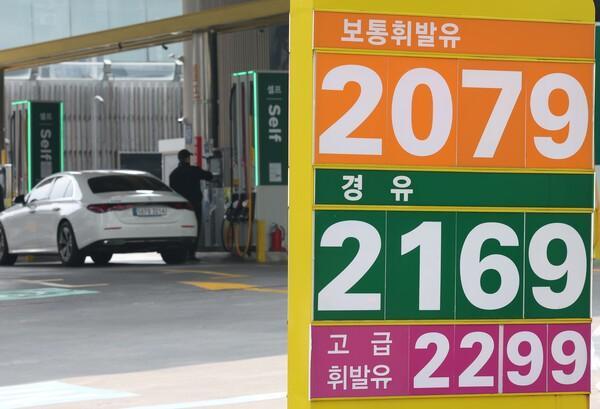
The Ministry of Trade, Industry and Energy said Thursday the measure will set a ceiling on the wholesale prices oil refiners charge gas stations and distributors for key petroleum products, though retail prices at individual gas stations will not be directly regulated.
The initial ceiling, effective from March 13 to March 26, is set at 1,724 won ($1.16) per liter for gasoline, 1,713 won for diesel and 1,320 won for kerosene. The levels are 109 won, 218 won and 408 won lower, respectively, than the average supply prices refiners reported on March 11.
Authorities said the caps will be reviewed every two weeks depending on global oil price movements.
The ceiling will be calculated based on refiners’ weekly average supply prices before the Middle East crisis, adjusted by fluctuations in the Mean of Platts Singapore (MOPS) benchmark and then adding taxes.
The government invoked a rarely visited clause in the Petroleum Business Act that allows authorities to designate maximum prices when oil market volatility threatens economic stability. It marks the first enforcement of the system since South Korea liberalized petroleum pricing in 1997.
Industry Minister Kim Jung-kwan said the move aims to stabilize fuel costs while preventing excessive price hikes that could distort the market.
“The government decided to introduce the petroleum price cap system to stabilize oil prices, respond to unreasonable price increases and ensure that the burden of rising fuel costs is shared among the government, businesses and the public,” Kim said during a ministerial task force meeting on consumer prices.
Officials also warned they will closely monitor market behavior, including possible hoarding or excessive price hikes at gas stations not directly covered by the cap.
Under the program, exports of petroleum products subject to the ceiling may also be restricted to prevent domestic supply shortages caused by price gaps with overseas markets.
The government said any financial losses incurred by refiners will be reviewed and compensated after the program ends, subject to strict verification.
The emergency measure comes as domestic fuel prices have surged sharply since the outbreak of the latest Middle East conflict on Feb. 28, when the United States and Israel launched airstrikes on Iran.
According to the Korea National Oil Corp., the nationwide average retail gasoline price climbed to 1,904.3 won per liter, up from 1,692.6 won before the conflict. Diesel prices rose even faster, reaching 1,927.5 won per liter from 1,597.2 won over the same period.
Global oil markets have also swung sharply higher as the war threatens shipping through the Strait of Hormuz, a chokepoint for about 20 percent of global seaborne crude flows.
Brent crude surged 9.2 percent to $100.46 per barrel Thursday — its largest one-day jump since 2020 — while U.S. benchmark West Texas Intermediate (WTI) rose 9.7 percent to $95.73.
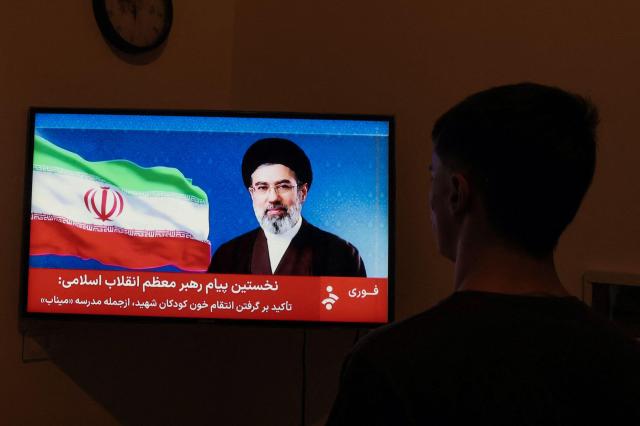
The threat of prolonged disruption to global oil shipments has heightened concerns of a sustained energy price shock, prompting governments across Asia to prepare emergency stabilization measures.
Seoul said it will lift the price cap once domestic fuel markets stabilize, while continuing efforts to secure additional crude supplies outside the Middle East and prepare potential releases from strategic petroleum reserves.
Copyright ⓒ Aju Press All rights reserved.
