
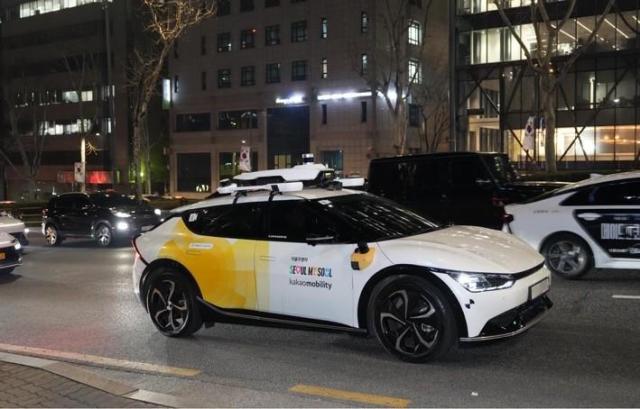
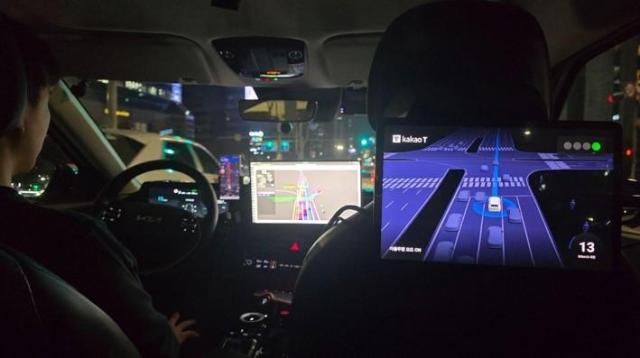
According to industry officials on the 16th, Kakao Mobility began operating a self-driving taxi service in parts of Gangnam starting that day.
The late-night service uses Kia EV6 vehicles, but the autonomous driving system is Kakao Mobility’s in-house “AI Planner.” The company said it has built end-to-end (E2E) autonomous driving technology that allows AI to perceive and make decisions, based on complex urban driving data collected in areas such as Pangyo and Gangnam. The taxis operate in a designated autonomous driving pilot zone on weekdays from 10 p.m. to 5 a.m. the next day.
In South Korea, autonomous driving is expanding largely through public transportation. Companies such as Autonomous A2Z and RideFlux have worked with local governments in Seoul, Busan and Daegu to deploy autonomous solutions and build real-world testing experience.
Hyundai Motor was selected for the Ministry of Land, Infrastructure and Transport’s “K-Autonomous Driving Cooperation Model” project and plans to deploy 200 Ioniq 5-based self-driving vehicles in phases in Gwangju starting in the second half of this year. Motional, Hyundai Motor’s autonomous driving joint venture, is pushing to fully commercialize unmanned robotaxis in Las Vegas by year’s end.
Interest is also growing in autonomous features for privately owned vehicles. A survey last month by Chabot Mobility of 450 prospective new-car buyers found 76.5% were interested in subscribing to autonomous driving functions.
Tesla and General Motors have introduced autonomous driving features in South Korea, but broader adoption remains limited. Hyundai Motor last year said it would use its autonomous driving technology “Atria AI” to deliver Level 2+ capabilities comparable to Tesla’s FSD (Full Self-Driving) by 2027.
Hyundai Motor autonomous driving affiliate 42dot has been developing an E2E model based on cameras and radar and began large-scale hiring in January.
Still, profitability remains uncertain given heavy investment. 42dot posted an operating loss of 349.7 billion won last year, about doubling the size of its loss from a year earlier. Motional, which is responsible for the robotaxi business, also faces continued large investment burdens until commercialization.
Attention is focused on whether Park Min-woo, recently appointed CEO of 42dot and head of Hyundai Motor’s Advanced Vehicle Platform (AVP) division, can shift the momentum. A Hyundai Motor official said, “The direction of the autonomous driving business could be flexible depending on the new CEO’s perspective,” adding, “There is a possibility that a concrete plan related to autonomous driving will be presented at this year’s investor day.”
* This article has been translated by AI.
Copyright ⓒ Aju Press All rights reserved.