
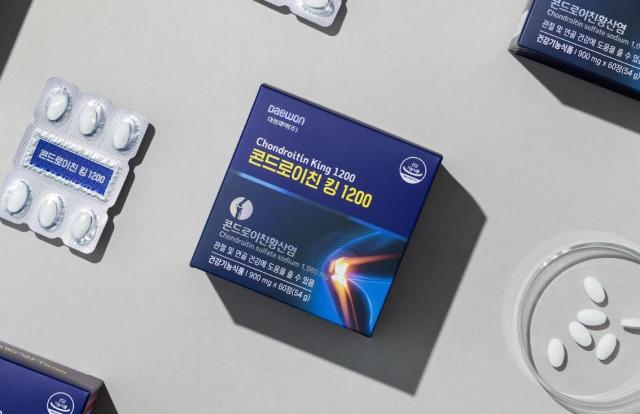
Daewon Pharmaceutical said March 18 that its health supplement brand Daewon Health has launched “Chondroitin King 1200,” a functional health food that may help support joint and cartilage health.
The product’s main ingredient is chondroitin sulfate, which has been recognized by the Ministry of Food and Drug Safety for joint and cartilage health functionality. The company said it is the first and only individually approved functional ingredient used in a chondroitin health supplement made by a domestic pharmaceutical company.
Daewon said it selected an ingredient with more than 90% purity and the same structure as chondroitin found in human cartilage. Users can take two tablets once a day to supplement 1,200 milligrams of the main ingredient.
The company said a human study also verified improvements in objective indicators related to joint health management. In a 90-day intake test involving 137 men and women ages 40 to 75, it said there were significant improvements in levels of inflammation-related factor TNF-α and inflammation-inducing factor COX-2.

Ilyang Pharmaceutical said March 18 that its final victory in a dispute over undistributed profits with its Chinese joint venture, Tonghua Ilyang, was selected as a model case in an official work report by China’s top judicial body.
The company said the Supreme People’s Court included the dividend-rights dispute in the “five major cases in China’s judicial field” released in its work report to the National People’s Congress.
The court described the case as a representative judicial example showing “opening up to the outside world through equal protection,” and as “a model case for protecting the rights and interests of foreign investors and resolving international investment disputes.”
Ilyang said the key point in the report was a ruling ordering Tonghua Ilyang to pay dividends of about 18 billion won in undistributed profits, allowing recovery of the full amount that had been tied up for more than three years.

Mogam Institute for Biomedical Research said March 18 that it was selected on March 11 as a partner institution for the Ministry of Science and ICT’s nationwide artificial intelligence research and innovation program, the “K-Moonshot” project, and signed a memorandum of understanding.
K-Moonshot is a mission-driven program aimed at boosting productivity in science and technology research through AI and tackling key national missions. Participating organizations will cooperate to build an AI-based research innovation ecosystem by providing AI resources, conducting joint R&D and collaborating on data use.
Mogam said it will participate as a partner in the “advanced bio and new drug development” area among 12 national missions. The institute said it plans to use its AI-based drug development capabilities to help improve productivity and research efficiency in the drug development process.
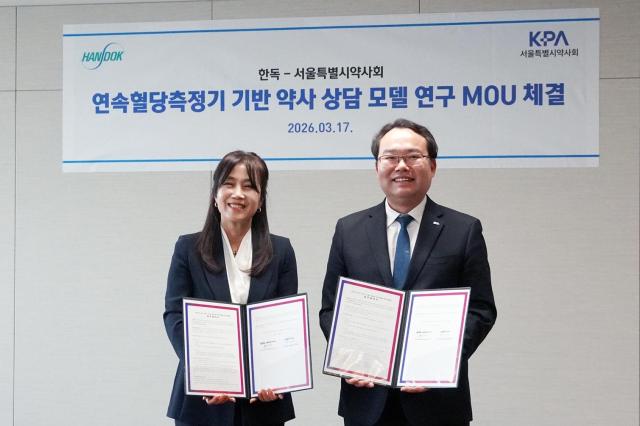
Handok and the Seoul Pharmacists Association said March 18 they signed an agreement the previous day at Handok’s headquarters in Yeoksam-dong to cooperate on research into pharmacist services and personal health management based on continuous glucose monitoring, or CGM.
The partners said the goal is to build practical evidence that standardized education, counseling and behavior-coaching services can be provided systematically using CGM data. They also aim to develop guidance on standardized CGM use and diabetes education guidelines that can be applied in pharmacies.
The study will be led by the Seoul Pharmacists Association and will involve 150 participants. Subjects will be divided into three groups based on whether they wear a CGM device and the level of pharmacist intervention: a non-wearing group; a wearing group without pharmacist intervention; and a wearing group that receives pharmacist counseling.
The non-wearing group will receive basic medication guidance. The wearing group without pharmacist intervention will also receive training on how to use the device. The wearing group with pharmacist counseling will have regular counseling at least once a week. Researchers will analyze changes in blood glucose patterns and the overall effects of pharmacist counseling based on these differences.
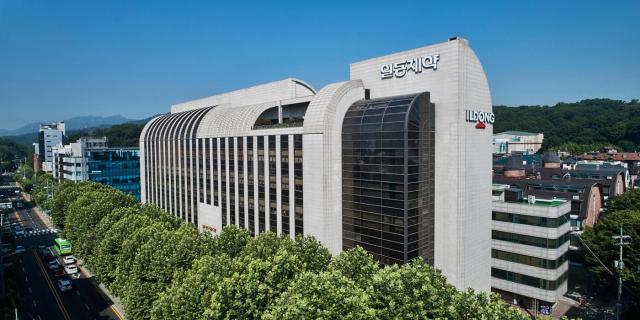
Idience, Ildong Pharmaceutical Group’s oncology drug development affiliate, said March 18 that the U.S. Food and Drug Administration granted fast-track designation for its targeted anticancer drug candidate Venadaparib.
Fast track is an FDA program intended to speed development and review of drugs for serious conditions when they may offer meaningful improvement over existing therapies or address unmet medical needs.
With fast-track status, a developer can consult more closely with the FDA during development and may use expedited procedures such as rolling submissions and applying for priority review.
Venadaparib is a next-generation PARP inhibitor designed to suppress cancer by selectively acting on PARP1, an enzyme involved in repairing DNA damage in cells. The company said the FDA designated it in 2022 as an orphan drug for gastric cancer.
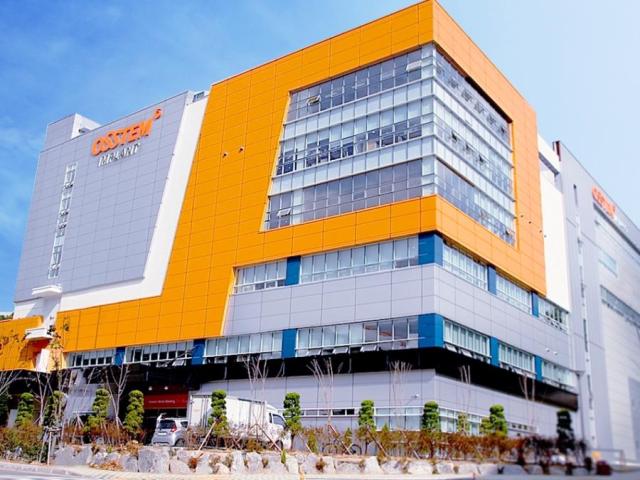
Osstem Implant said March 18 that its K1 (Orange Tower) implant manufacturing plant was recertified by the Ministry of Food and Drug Safety as compliant with Korea Good Manufacturing Practice, or KGMP, standards for medical device manufacturing and quality control.
The company said K1 has built a strict quality management system across all processes to produce and supply high-quality products. It operates “management by six key processes” and a “five-step precision inspection system,” and is aiming for a defect rate of 100 parts per million, or no more than one defect per 10,000 units.
Osstem said it runs a full inspection system from raw material receipt through shipment of finished products, while continuing investments to upgrade manufacturing conditions, including clean rooms, deionized water facilities and robotic processes.
The company said it has built the same level of quality management at its nearby K2 plant. K2, which began full operations in the second half of 2023, has a total floor area of 13,699 square meters (about 4,144 pyeong) and an annual maximum capacity of 12 million implant sets. Osstem said K2 is scheduled to undergo a regular audit in April for KGMP compliance certification.
* This article has been translated by AI.
Copyright ⓒ Aju Press All rights reserved.