SEOUL, May 07 (AJP) - Samsung Electronics has much to celebrate — joining the rare ranks of companies generating more than $40 billion in quarterly profit and surpassing a $1 trillion market capitalization.
Yet beneath the triumph, the company faces growing internal strains that mirror the strengths and vulnerabilities of the broader Korean economy, heavily hanging on the semiconductor boom.
The founding principle of “One Samsung” is showing visible cracks as divisions drift further apart — financially, culturally and strategically.
The gap is most stark between the Device Solutions (DS) division, which oversees semiconductors, and the Device eXperience (DX) division, responsible for mobile devices and home appliances.
In the first quarter, DS generated 53.7 trillion won ($39.2 billion) in operating profit, accounting for nearly 94 percent of the company’s earnings. DX contributed a comparatively modest 3 trillion won ($2.2 billion).
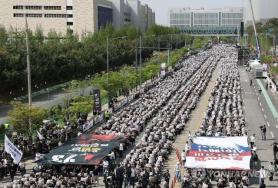
The widening imbalance has begun spilling into labor relations. According to union sources, more than 2,500 DX employees recently withdrew from the representative labor union, SELU, arguing that they were being sacrificed to bankroll ever-fatter paychecks for semiconductor workers.
Unionized employees within the DS division counter that their demands are aimed at ensuring compensation remains competitive with industry rivals.
“The friction is less about the absolute amount than about maintaining rewards that remain competitive against our peers,” a union official from the DS division said.
The official worried that prolonged disputes over compensation could eventually accelerate an outflow of talent to rival chipmakers, posing a longer-term threat to the company’s competitiveness.
Discontent within DX also reflects growing anxiety over the rapid rise of Chinese competitors in consumer electronics and home appliances.
Amid deteriorating performance, Samsung has decided to withdraw its money-losing home appliance and television sales operations in China.
On Wednesday, the company informed local partners and employees of the decision, citing intensifying competition and a rapidly shifting business environment.
While Samsung will retain its NAND flash production facility in Xi’an and its appliance factory in Suzhou, the withdrawal has already triggered demands from local employees for “restructuring incentives.”
According to industry trackers, Samsung — which once commanded nearly 20 percent of China’s television market in 2005 — has seen its offline retail market share collapse to just 3.62 percent as of April 2026, far behind local competitors.
The picture is even bleaker in white goods, where Samsung’s market share in refrigerators and washing machines has fallen below 0.5 percent this year.
China’s consumer electronics market has become brutally competitive, with rapid technological catch-up by domestic firms and growing concerns over technology leakage making profitability increasingly elusive for foreign players.
China's ascent is no longer confined to the home turf. According to 2025 data from Counterpoint Research, Chinese manufacturers TCL and Hisense captured a combined 25 percent share of the global TV market by shipment volume, overtaking the combined 24 percent held by Samsung and LG. Samsung accounted for 15 percent and LG 9 percent.
Still, "it would be unreasonable to interpret this as Samsung giving up on home appliances altogether, as its premium image remains strong in many global markets,” said Hwang Yong-sik, a business administration professor at Sejong University.
“A period of selection and concentration has arrived, and Samsung appears to be reinforcing its portfolio around high-tech AI and semiconductors.”
Hwang added that the simultaneous labor strife is also a structural byproduct of managing a sprawling conglomerate.
Unlike SK hynix, which effectively operates as a pure semiconductor company, Samsung houses multiple strategic business units under a single corporate structure, making differentiated, performance-based compensation an almost inevitable source of tension.
“This labor-versus-labor conflict is an expected outcome stemming from the need to distribute incentives differently across business units, combined with South Korea’s institutional framework allowing multiple unions,” Hwang said. “It is not simply a management failure, but a structural issue inherent to Samsung’s diversified portfolio and Korea’s labor system.”
Unionized workers have warned of a potential full-scale strike later this month if negotiations remain deadlocked — a scenario that could inflict serious damage on Samsung’s core semiconductor operations, which run continuously around the clock. “A court will rule on May 20 on the company’s injunction request seeking to block a strike on grounds that semiconductors constitute a strategic national industry.”
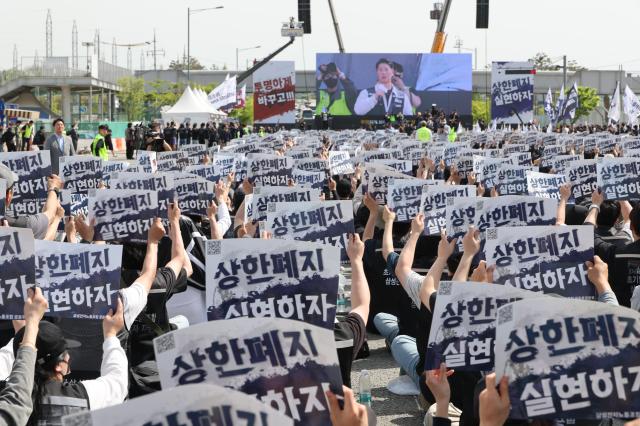
Although semiconductor fabrication plants are highly automated, industry analysts estimate that even partial disruptions to logistics or manual processes could result in substantial daily losses.
Should disruptions escalate into a full production halt, estimated daily losses could climb as high as 1 trillion won ($730 million). Any deterioration in chip yields or wafer damage caused by operational interruptions would be especially costly as Samsung races to meet surging global demand for high-bandwidth memory (HBM) chips.
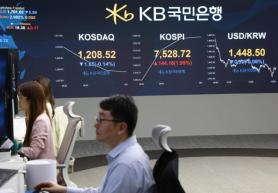
Shares of Samsung Electronics hit new historic high, closing Thursday 2.8 percent up at 273,500 won.

Copyright ⓒ Aju Press All rights reserved.