
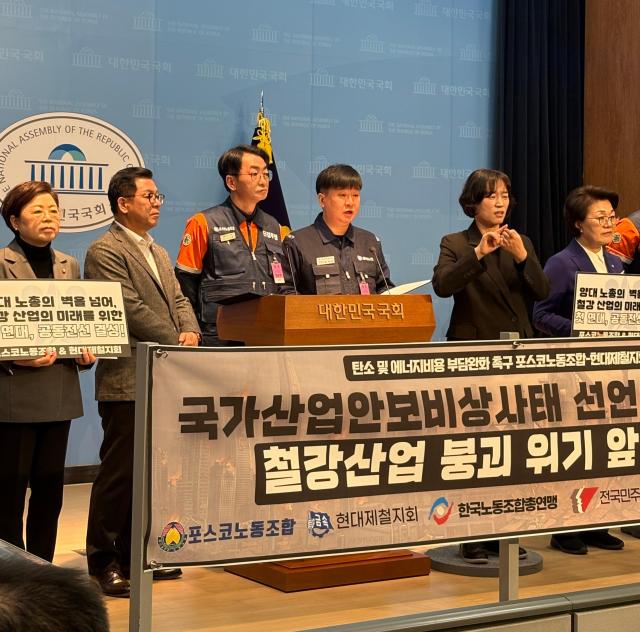
Labor unions at POSCO and Hyundai Steel held a joint news conference March 19 at the National Assembly press center, urging the government to ease the burden of industrial electricity rates and carbon-related costs.
The unions called for measures including relief on industrial power bills, improvements to the carbon emissions-permit system and expanded financial and infrastructure support for shifting to cleaner processes such as hydrogen-based steelmaking.
Kim Seong-ho, chair of the POSCO union under the FKTU-affiliated Korea Metal Workers’ Federation, said the industry is being squeezed by sharply worsening profitability, stronger protectionism in advanced economies and what he described as astronomical carbon-emissions costs. He said the government should step in with practical support.
Kim said it was the first time in POSCO’s 57-year history that its union had joined Hyundai Steel in a coordinated response, underscoring the severity of the crisis.
Song Jae-man, head of Hyundai Steel’s Pohang branch under the KCTU-affiliated Korean Metal Workers’ Union, said industrial electricity rates have risen about 85% over the past five years while steel output has dropped sharply, pushing the industry to its limits. He said plant downsizing and job insecurity are becoming reality and are weighing on local economies.
The unions also cited added pressure from war risk involving Iran, saying the steel industry relies heavily on imported raw materials, making it vulnerable to higher oil prices and exchange-rate swings.
A union official said even a small rise in the exchange rate can sharply increase fixed-cost burdens, and that weak market conditions combined with energy costs have pushed worksites to the brink.
On the government’s recently announced electricity-rate overhaul, the unions said steelmaking is a continuous, 24-hour process and could be hit harder by higher nighttime rates than helped by lower daytime rates, limiting any real relief.
Lawmakers attending the event included Rep. Lee Sang-hwi of the People Power Party, Rep. Kwon Hyang-yeop of the Democratic Party and independent lawmaker Kim Jong-min, who voiced support for a joint response to the steel industry’s challenges.
* This article has been translated by AI.
Copyright ⓒ Aju Press All rights reserved.