
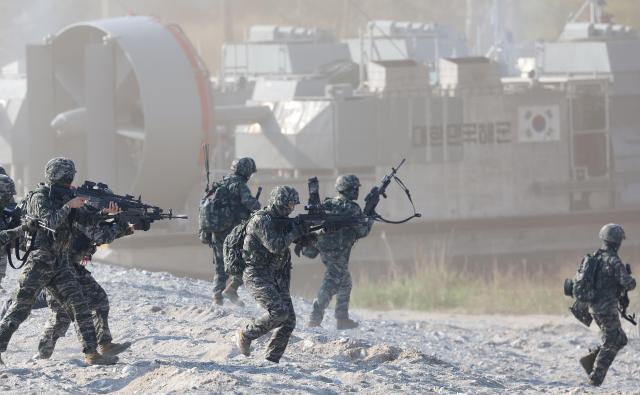
During a cabinet meeting on Tuesday, President Lee Jae Myung delivered a lecture on the imperative of national self-reliance.
"A nation must be able to defend itself. Why should we rely on others?"
Lee bolstered his reasoning by citing South Korea’s current military standing: the world’s fifth-largest defense capability (independent of U.S. assets) and its position as the fourth-largest global arms exporter.
The entrenched U.S. engagement in the Middle East after attacks on February 28, 2026 has precipitated this urgency. The financial burden on Washington is mounting; as of early April, the U.S. is estimated to have spent $35 billion on the conflict. Analysts project that total costs could exceed $1 trillion if the war continues to drag on.
Amid this distraction, North Korea has ramped up its military provocations. In April alone, Pyongyang conducted four ballistic missile launches from Wonsan on April 8 and from the Sinpo area on April 19, raising the possibility of submarine-launched ballistic missile (SLBM) testing.
The North also claimed to have tested short-range ballistic missiles equipped with cluster munitions between April 6 and 8.
On paper, South Korea maintains a significant conventional advantage; its annual defense budget exceeds North Korea’s entire GDP. However, as the contemporary wars in Ukraine and Iran have demonstrated, firepower alone does not guarantee victory.
Professor Kim Houng-yu of the Korea Defense Industry Association notes that "no country conducts war operations in isolation in modern conflict." He argues that military rankings are often deceptive, pointing to the Russia-Ukraine war as proof that even major powers face grueling uncertainty on the battlefield. "Alliances and coalition operations remain essential for national security," Kim concluded.
Despite the rhetoric of self-reliance, several "anchors" keep the U.S.-ROK alliance in place.
Under the U.S. National Defense Authorization Act, the number of U.S. troops stationed in South Korea is capped at 28,500, making any abrupt reduction difficult without congressional approval.
Some analysts also note that the U.S. 2026 National Defense Strategy calls for maintaining “primary responsibility” for deterring North Korean conventional threats while continuing close coordination with the United States.
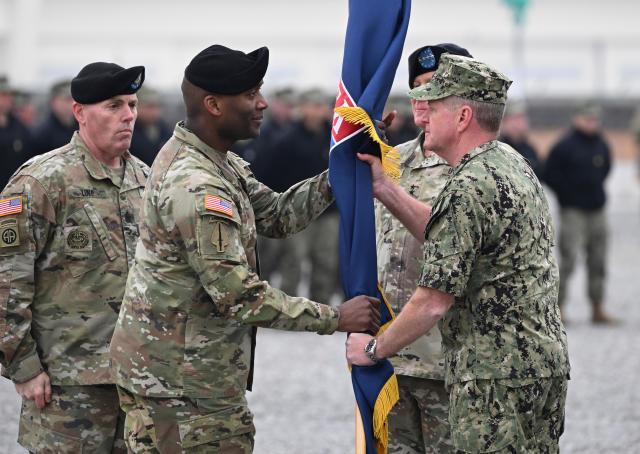
Recent months have seen visible friction in bilateral coordination. In January, Seoul requested a reschedule of trilateral air drills with the U.S. and Japan, citing the Lunar New Year and Japan's provocative "Takeshima Day." The U.S. ultimately proceeded with the drills alongside Japan only.
Further tension surfaced on February 18–19, when U.S. Forces Korea conducted independent operations over the Yellow Sea. This prompted a standoff with Chinese fighter jets and a subsequent protest from South Korean Defense Minister Ahn Gyu-back regarding a lack of prior consultation. General Xavier Brunson reportedly issued an apology, and the drills were truncated from four days to two.
Japan’s recent policy shifts add a layer of complexity. With roughly 55,000 U.S. troops on its soil, Tokyo is revising export rules to allow for the transfer of lethal weapons. This signals a move toward active combat readiness.
Professor Hosaka Yuji of Korea University suggests this is a calculated alignment with Washington. "The Takaichi administration is leaning into cooperation with the Trump administration," he noted, highlighting that Japan is seeking a partnership that covers not just Chinese containment, but also the securing of critical resources like rare earths.
As the U.S.-Iran conflict shows no sign of abating, South Korea is caught in a delicate balancing act. The trajectory of the alliance will be defined by how well Seoul can reconcile its goal of a self-reliant defense with the harsh realities of geopolitical interdependence.

Copyright ⓒ Aju Press All rights reserved.
