
The theme of the Korea Pavilion at this year’s Venice Biennale, opening in May, is “Liberation Space: Fortress and Nest.” The exhibition revisits the “liberation space” of 1945 to 1948 — the transitional period after Korea’s liberation from Japanese colonial rule and before the establishment of a new state — and extends it as an ongoing question in the present, reexamined through aesthetics. Nobel literature laureate Han Kang is also taking part.
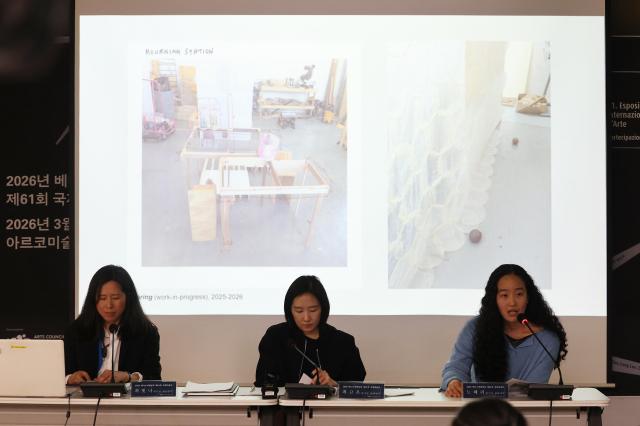
Choi Bitna, the artistic director overseeing the Korea Pavilion exhibition, said at a March 19 news conference at the ARKO Art Center in Seoul that Han’s Nobel lecture resonated with her. “As the line ‘Can the past help the present? Can the dead save the living?’ gave an echo, I couldn’t help but ask what role art — or I — can play,” she said.
Choi added that the “Dec. 3 illegal martial law incident,” impeachment and a change of government awakened a shared civic awareness among South Koreans about the country’s formation and the development of its democratic system. “I hoped I could do something, with a sense of repaying those who stood in the square for a long time,” she said.
The pavilion will be presented anew as a temporary monument for “liberation space,” described as both a site of liberation and an ongoing space for practicing a new concept of sovereignty. Artists Choi Go-eun and Noh Hyeri will present sculptural installations and performance-based works titled “Meridian” and “Bearing,” respectively.
Choi said she focused on 1995, when the Korea Pavilion was built. “That was when the Gwangju Biennale was first held and the Korea National University of Arts was established. The demolition of the former Japanese Government-General building also began,” she said. “It was a moment of transition.”
The pavilion will also invite fellows from across cultural and social fields, including novelist Han. Han is not expected to attend the exhibition opening, according to the organizers.
Noh said Han created a sculpture titled “Funeral,” which will be exhibited alongside her work. “The community not only saved people, it also killed many people. She will speak about that,” Noh said. She added that “Funeral” realizes in sculpture a scene from a dream that became a motif for Han’s novel “I Do Not Bid Farewell.” Two anthologies to be published in place of a catalog will include Han’s writing, including pages 1 and 2 of “I Do Not Bid Farewell.”
The Korea Pavilion will also pursue cooperation with the Japan Pavilion, described as the first such collaboration between the only two Asian national pavilions in the Giardini.
Hyundai Motor Co. is the exhibition’s official sponsor. Bulgari Korea, the Doosan Yonkang Foundation, Shinhan Bank and individual donors are also providing support.
* This article has been translated by AI.
Copyright ⓒ Aju Press All rights reserved.