SEOUL, March 23 (AJP) - A research team at the Korea Advanced Institute of Science and Technology (KAIST) has developed a technology to control hydrogen sulfide using electrical signals, turning a gas typically known for its toxic nature and foul odor into a precise medical treatment tool.
KAIST said Monday that the study, led by the Department of Chemical and Biomolecular Engineering's Professor Park Ji-min, introduces a bioelectronic platform capable of generating and delivering hydrogen sulfide to specific locations at exact times. This development marks a significant step toward precision medicine, where treatments can be applied to targeted areas without systemic side effects.
Hydrogen sulfide is often associated with the smell of rotten eggs and is known as a hazardous substance. However, recent biological research has identified it as a crucial signaling molecule in the human body that maintains cell health and regulates protein functions by acting as a chemical switch.
While it has therapeutic potential, hydrogen sulfide is difficult to use in medicine because it is a highly reactive gas that disappears quickly. Controlling its concentration and delivering it to a specific organ or tissue has remained a major technical challenge until now.
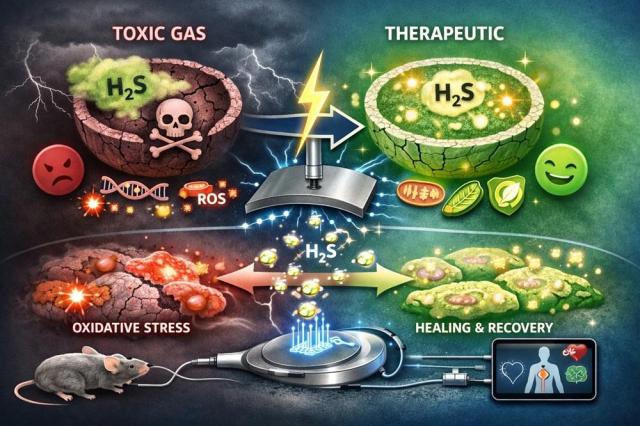
To solve this, the KAIST team drew inspiration from bacterial systems to create a method that applies electricity to thiosulfate, a substance safe for the human body, to produce hydrogen sulfide. This electrochemical approach offers much higher safety and precision than traditional chemical injection methods.
The researchers identified silver as the most effective material for the electrodes. Silver electrodes selectively promote the production of hydrogen sulfide while minimizing unnecessary side reactions, allowing for the fine-tuning of the gas amount and release speed simply by adjusting the voltage and timing.
Testing the platform on human-derived cells, the team successfully activated specific ion channels that sense pain and stimuli. Furthermore, when applied to cells damaged by oxidative stress, the electrically controlled hydrogen sulfide restored cellular balance and promoted healing with virtually no observed toxicity.
"This research is significant because it transforms hydrogen sulfide, once considered only a toxic substance, into a new tool for regulating biological systems via electrical signals," Professor Park Ji-min said. He added that the technology has high potential for expansion into digital healthcare and precision medical devices for treating neurological and cardiovascular diseases.
The findings were published on March 19, 2026, in the international journal Science Advances.
(Reference Information)
Journal/Source: Science Advances
Title: Bioelectronic Synthesis of Hydrogen Sulfide Enables Spatiotemporal Regulation of Protein Modification and Cellular Redox
Link/DOI: https://doi.org/10.1126/sciadv.aeb3401

Copyright ⓒ Aju Press All rights reserved.