SEOUL, April 19 (AJP)-South Korea’s government debt burden is set to cross a key threshold next year, overtaking the average of advanced economies without reserve currencies, as fiscal expansion continues to outpace economic growth, according to the latest assessment by the International Monetary Fund.
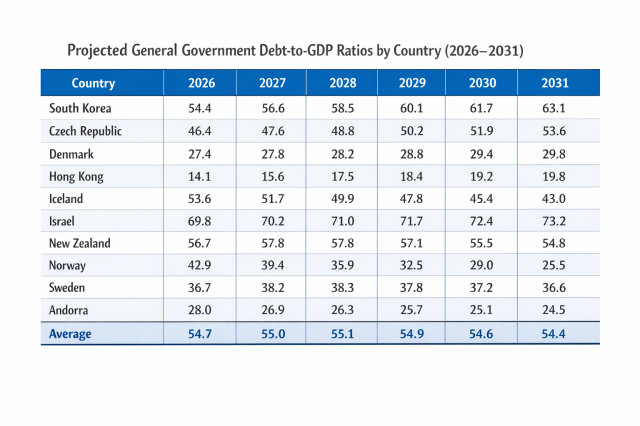
The IMF projected in its April Fiscal Monitor that Korea’s general government debt-to-GDP ratio will rise from 54.4 percent this year to 56.6 percent in 2027, exceeding the 55.0 percent average for a group of 11 advanced non-reserve-currency economies that includes the Czech Republic, Denmark and Sweden.
The crossover marks a symbolic shift for a country long viewed as fiscally conservative among advanced economies, highlighting how quickly its debt trajectory has steepened since the pandemic.
The broader trend reflects a structural imbalance: debt is rising significantly faster than the economy. Between 2020 and 2025, Korea’s nominal GDP expanded at an annual average of 5.3 percent, while central and local government debt (D1) grew at 9.0 percent — roughly 1.7 times faster.
That divergence is now feeding directly into the debt ratio, a key gauge of fiscal sustainability.
The IMF expects Korea’s debt ratio to rise by 8.7 percentage points over the next five years, reaching 63.1 percent by 2031. That marks the steepest increase among the 11 comparator economies and the second-fastest pace after Hong Kong.
In contrast, several peers — including Norway, Iceland and New Zealand — are projected to reduce their debt burdens over the same period.
The IMF flagged Korea, alongside Belgium, as one of the countries facing “significant increases” in debt levels, underscoring mounting concerns over medium-term fiscal dynamics.
At around the mid-50 percent range, Korea’s debt ratio still remains well below that of Group of Seven economies, where averages typically run between 120 percent and 130 percent of GDP.
But unlike the United States or Japan, Korea does not issue a global reserve currency — a distinction that limits its flexibility during external shocks. Non-reserve currency economies tend to face sharper capital outflows and exchange rate volatility in times of stress, requiring stricter fiscal discipline.
This structural constraint makes the pace of debt accumulation more consequential than the level itself.
The IMF’s latest report also points to a worsening global fiscal backdrop. It warned that government balance sheets are facing structural deterioration amid higher borrowing costs and geopolitical shocks, including spillovers from the Middle East conflict.
Globally, public debt is projected to exceed 100 percent of GDP by 2029, driven by persistent spending pressures and rising interest burdens.
Key risks include war-related fiscal outlays, protectionism, shifts in sovereign bond markets and demographic aging — all factors that could further strain public finances.
Against this backdrop, the IMF urged governments to adopt clearer medium-term fiscal frameworks while reallocating spending toward growth-enhancing investments.
It also recommended targeted and temporary support measures to cushion households from energy price shocks, rather than broad-based subsidies.
Seoul has signaled alignment with such guidance, emphasizing selective support for vulnerable groups and a restructuring of rigid expenditures to free up resources for strategic sectors such as artificial intelligence and future industries.
Copyright ⓒ Aju Press All rights reserved.