
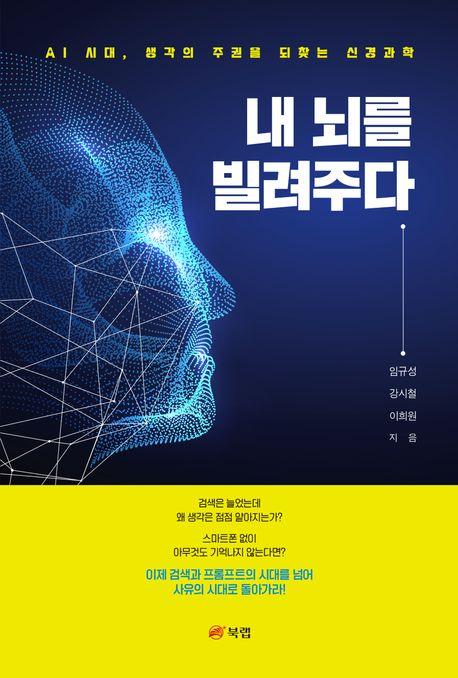
BookLab recently published “Lending My Brain — Neuroscience to Reclaim the Sovereignty of Thought in the AI Era.” The book examines how reliance on search changes memory formation, how short-form content reshapes attention systems, and how GPS use affects spatial cognition and the hippocampus. It also offers practical strategies aimed at restoring cognitive skills.
The book is co-authored by three experts in medicine, management and technology: Lim Gyu-seong, a gastroenterology and hepatology specialist and medical doctor who heads GenosisAI Healthcare; Kang Si-cheol, a management Ph.D. and AI technology adviser to Seoul Medical Center who serves as vice chairman of GenosisAI Healthcare; and Lee Hui-won, chairman of GenosisAI Healthcare, who has led development of third-generation Human Digital Twin technology.
The authors argue that while people in the 21st century have unprecedented access to information, their ability to internalize it is rapidly weakening. Citing research on the so-called “Google Effect,” they say outsourcing memory to digital tools brings measurable changes to synaptic plasticity and long-term potentiation mechanisms, and that cognitive decline can damage creativity, critical thinking and judgment.
They also focus on the imprint of algorithmic curation and short-form content on cognition. The book describes the neuroscience basis of filter bubbles and confirmation bias, and uses the “popcorn brain” and “dopamine loop” theories to explain how consuming videos in 15-second bursts can fragment attention.
As a remedy, the authors propose “cognitive friction,” a strategy of deliberately introducing inconvenience to restore deeper thinking. They outline an “eight-week cognitive sovereignty recovery program” that includes reading paper books, allowing the default mode network to activate through idle time, remembering routes without a map, and writing by hand.
The book broadens into a philosophical question about balancing technology and humanity. The authors urge readers to choose between passively receiving information and living as thoughtful creators, framing the central challenge as a shift from knowledge to wisdom and from cognitive offloading to cognitive sovereignty.
* This article has been translated by AI.
Copyright ⓒ Aju Press All rights reserved.