
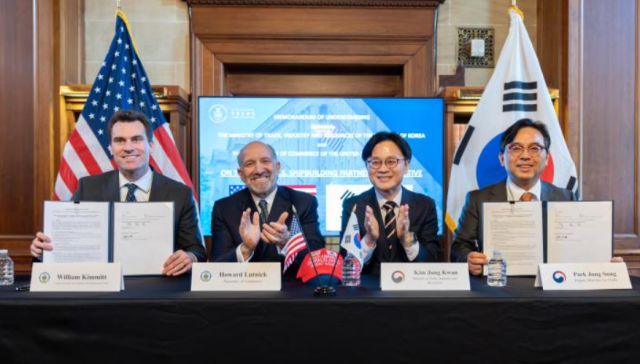
The U.S. Department of Commerce and South Korea’s Ministry of Trade, Industry and Resources (MOTIE) signed a memorandum of understanding in Washington establishing the Korea-U.S. Shipbuilding Partnership Initiative (KUSPI), a bilateral platform designed to deepen cooperation in commercial shipbuilding, industrial modernization, maritime manufacturing investment and workforce development.
The agreement marks the operational launch of what Seoul has branded the MASGA initiative — shorthand for “Make American Shipbuilding Great Again” — which formed a central pillar of Korea’s commitment to invest $350 billion in the United States under last year’s trade understanding with Washington. Of the total, $150 billion was earmarked for revitalizing the U.S. shipbuilding sector.
The signing comes at a delicate moment for Seoul’s trade strategy, as Korean exporters continue to navigate uncertainty surrounding President Donald Trump’s evolving tariff policies. U.S. courts have recently delivered a series of rulings questioning the legal foundation of several Trump-era tariff mechanisms, including challenges to “global reciprocal tariffs” imposed under emergency authorities.
While the court setbacks have raised hopes in Seoul that some tariff pressure may eventually soften, Korean officials remain wary that Washington still retains powerful trade tools under Section 301 of the Trade Act, which allows the U.S. administration to impose tariffs or retaliatory measures over alleged unfair trade practices.
Seoul’s aggressive investment push into strategic American industries such as shipbuilding is increasingly viewed as both an industrial partnership and a geopolitical hedge aimed at reducing bilateral friction with Washington.
The MOU was signed by Park Jung-sung, South Korea’s deputy trade minister, and William Kimmitt, U.S. under secretary of commerce for international trade, under the oversight of Industry Minister Kim Jung-kwan and U.S. Commerce Secretary Howard Lutnick.
Under the agreement, the two governments will establish a Korea-U.S. Shipbuilding Partnership Center in Washington later this year to coordinate collaboration among shipbuilders, suppliers, universities and research institutions from both countries.
Planned projects include facilitating foreign direct investment into the U.S. maritime industrial base, workforce training programs, shipyard productivity upgrades and technical exchanges.
“The MOU signing builds on ongoing U.S.-Korea cooperation in strategic industries and reflects continued efforts to strengthen allied industrial capacity, promote investment, and expand collaboration in advanced manufacturing sectors,” the U.S. International Trade Administration said in a statement.
The partnership also arrives amid growing alarm in Washington over the collapse of America’s shipbuilding capacity and increasing dependence on Asian allies for maritime industrial strength.
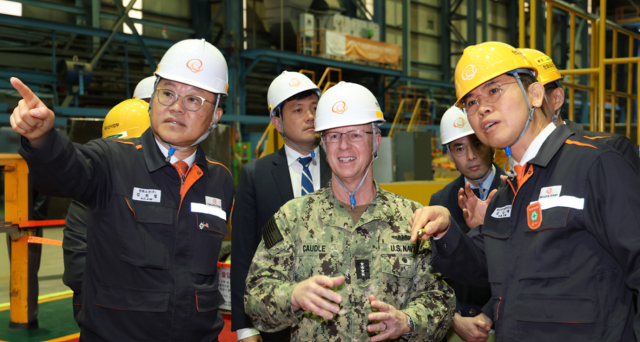
The report noted that the United States now produces only a handful of large commercial vessels annually compared with roughly 1,000 cargo ships built each year by China, while South Korea remains one of the world’s dominant shipbuilding powers.
It also spotlighted Hanwha’s acquisition and modernization of the Philadelphia shipyard as a symbol of Korea’s growing role in reviving U.S. maritime manufacturing.
In the program, Hanwha executives said the company plans to invest up to $5 billion into the Philadelphia yard and expand production capacity from roughly one ship per year to as many as 20 annually through automation, robotics and workforce expansion.
The report framed the issue not simply as industrial policy but as a national security imperative for Washington amid intensifying competition with China and growing vulnerabilities in global supply chains. “Shipbuilding is a national security necessity,” Michael Coulter, Hanwha’s top executive overseeing U.S. operations, said in the broadcast.
“The U.S. needs to be able to secure our own commerce.” The strategic logic has increasingly aligned Korean industrial ambitions with U.S. geopolitical priorities.
For Seoul, the shipbuilding partnership offers an opportunity to lock Korean firms deeper into America’s industrial rebuilding push while potentially cushioning Korean exporters from future tariff escalation. For Washington, Korean capital and expertise provide one of the few realistic paths toward rebuilding a severely weakened domestic shipbuilding ecosystem.
The Trump administration has repeatedly described America’s maritime decline as a national security crisis, with Trump himself signing executive orders last year to prioritize shipbuilding revival and establish a White House office dedicated to the sector. The MOU signed Friday signals that South Korea is moving beyond pledges and into implementation.
Whether the MASGA initiative ultimately translates into large-scale projects, shipyard modernization and meaningful tariff relief for Korean industries may determine how durable the broader Seoul-Washington economic alignment becomes in an increasingly protectionist era.
Copyright ⓒ Aju Press All rights reserved.
