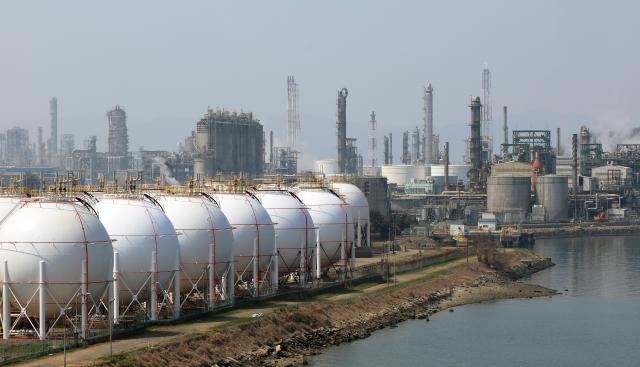
At first glance, alternative sourcing appears feasible. But industry officials say higher freight rates, refinery compatibility issues, and premiums on substitute crude could significantly raise costs.
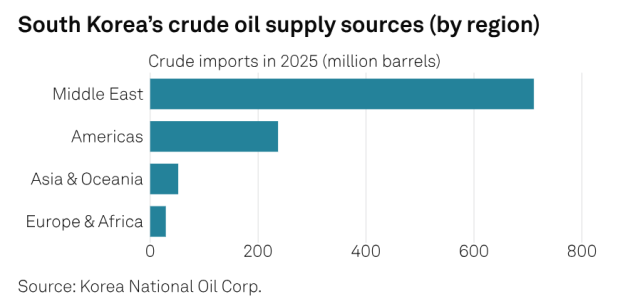
According to the Korea Petroleum Association and the Korea International Trade Association, the Middle East accounted for 70.7 percent of South Korea’s crude oil imports last year, followed by the Americas at 22.8 percent and the Asia-Pacific region at 4.3 percent — underscoring the country’s structural reliance on the region now at the center of geopolitical risk.
Crude oil is far from uniform. It varies by density — light versus heavy — and sulfur content — sweet versus sour. Middle Eastern grades such as Dubai and Saudi crude are typically heavier and more sulfur-rich, while U.S. West Texas Intermediate (WTI) and shale output tend to be lighter and sweeter.
Korean refiners have long optimized their facilities to process heavier Middle Eastern crude, making any abrupt pivot toward lighter alternatives far more complex than headline diversification suggests.
With the country importing roughly 3 million barrels per day, largely via maritime routes, refiners are now reviewing alternative sourcing scenarios spanning North America, Australia and UAE benchmarks such as Dubai and Murban.
Technically, these sources offer sufficient variation in quality to allow blending and substitution. The economics however are not straightforward.
Compared with the Middle East–East Asia route via the Strait of Hormuz, shipments from the United States can take nearly twice as long, raising overall transport costs even when freight rates themselves appear favorable.
Freight dynamics are already tightening. Daily charter rates for Very Large Crude Carriers (VLCCs) from the Middle East have surged to $150,000–$170,000 — the highest in six years — and analysts warn that diversified sourcing could further strain vessel availability and push up costs across routes.
Refinery efficiency poses another constraint. Facilities calibrated for heavier Middle Eastern crude risk lower yields and compressed margins if forced to process lighter North American or Australian grades.
“Switching crude types affects not only purchase prices but also refining conditions, catalyst use and maintenance cycles,” an oil industry official said. “In the short term, diversification may effectively mean paying an insurance premium.”
Still, some refiners have moved faster than others to hedge against concentration risk.
SK Innovation, long known for its aggressive diversification strategy, has expanded its North American exposure through the Trans Mountain Expansion (TMX) pipeline in Canada, which began full operations in mid-2024. By securing stable volumes of Canadian crude alongside frequent spot purchases of U.S. WTI, the company has materially reduced its reliance on Middle Eastern supply.
At the GS Caltex complex in Yeosu — the world’s fourth-largest single refinery with a capacity of 800,000 barrels per day — diversification efforts are also visible. Last week, the company imported roughly 1 million barrels of Kazakhstan’s Caspian Pipeline Consortium (CPC) crude via the tanker Nantucket from the Russian port of Novorossiysk, equivalent to fueling about one million passenger vehicles.
By contrast, S-Oil remains among the most exposed to Middle Eastern supply due to its long-term contracts with Saudi Aramco, its largest shareholder. While such arrangements provide stability, they also constrain flexibility. The company is expected to maintain core Saudi and UAE supply while gradually increasing imports of lighter grades and condensates linked to its Shaheen Project, a major petrochemical expansion underway in Ulsan.
HD Hyundai Oilbank continues to lead in diversification, with Middle Eastern dependence at roughly 40 percent as of 2025 — the lowest in the industry.
The company has broadened its sourcing footprint to include South American producers such as Guyana and Brazil, while incorporating North Sea grades from Europe. It was also the first Korean refiner to introduce Canadian crude, underscoring a long-standing strategy of supply flexibility.
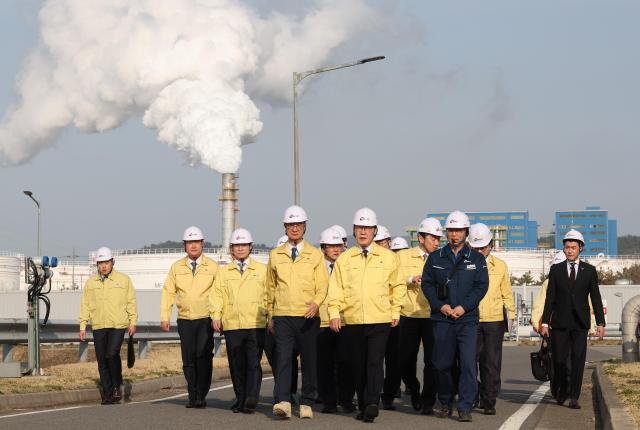
“If refiners need to modify their facilities to diversify crude supply beyond Middle Eastern sources, government-level support will also be necessary,” the official added.

Copyright ⓒ Aju Press All rights reserved.