Memorial Marks 4th Anniversary of Human Rights Lawyer Han Seung-heon’s Death
by Park HeewonPosted : April 22, 2026, 13:58Updated : April 22, 2026, 13:58
April 20, 2026, marked the fourth anniversary of the death of Han Seung-heon, a figure remembered not only in mourning but as a measure of conscience for his era.
His guiding line was simple: “Even if you can’t live proudly, don’t live in shame.” Supporters said it was not a slogan but a way of life.
Han was wary even of the label “human rights lawyer,” saying, “All lawyers are human rights lawyers.” Those who knew him said he treated the law not as a tool for the powerful but as a last safeguard for the vulnerable.
He was also known for humor that colleagues described as a form of resistance. When someone at a gathering asked for a show of hands from people defended by Han who had not gone to prison, he replied: “That’s right — but raise your hand if you went to prison and didn’t say goodbye to me.” He also joked, “Prosecutors call me anti-American, but I only drink Americanos.” In the last year of his life, he continued to share poetry and laughter, and died at Woosuk University Hospital in his hometown of Jeonju, the article said.
A memorial service held at Chinsu Hall at Jeonbuk National University, led by President Yang Oh-bong, brought together people who said Han devoted his life to the weak and persecuted, lived with integrity, and defended human dignity. Attendees included Kwon Noh-kap, chairman of the Kim Dae-jung Foundation; Father Song Gi-in; and singer Jang Sa-ik. Speakers also recalled that while his arguments could sound effortless, he repeatedly revised his work and prepared meticulously.
Han’s pen name, “Sanmin,” was described as meaning heavy like a mountain and humble like the people. The article said he understood it as a call to stay with ordinary people, choosing the margins of suffering over the center of power. His courtroom, it said, was “always the place of the weak,” and his advocacy “the voice of conscience.”
The article described three pillars of his life as self-discipline, autonomy and self-reliance, citing passages from the I Ching, the moral autonomy associated with Immanuel Kant, a Confucian ideal of following one’s heart without breaking rules, and a Zen teaching about being one’s own master wherever one stands.
Han was described as a rare figure in Korea’s judicial history to have served as a prosecutor and a lawyer and to have experienced the system as a suspect, a witness and a law professor. During military rule, the article said, he served as defense counsel in many political and conscience-prisoner cases and in cases involving torture victims. It said he challenged the logic of power in major cases including the Kim Dae-jung “insurrection conspiracy” case, and faced detention and repression but did not retreat.
At the memorial, his poem “My Path” was read, including the line, “I will go my way in silence.” Another poem included the vow to “become a single candle and light the darkness,” the article said.
The article also recounted an anecdote in which a journalist expressed surprise that Han was not a Seoul National University law graduate but a Jeonbuk National University law graduate, prompting a senior journalist to respond: “Throw away the two dogs called prejudice and preconception.” The article added that Han graduated first in his class at Jeonju High School and judged people not by labels but by how they lived.
Looking at today’s legal profession, the article said, large law firms, capital and the pursuit of material success risk turning law into technique and making justice seem relative. It argued that Han held to a basic principle: the law must exist for people. It concluded by returning to his line — “Don’t live in shame” — as a question it said today’s legal community must face.
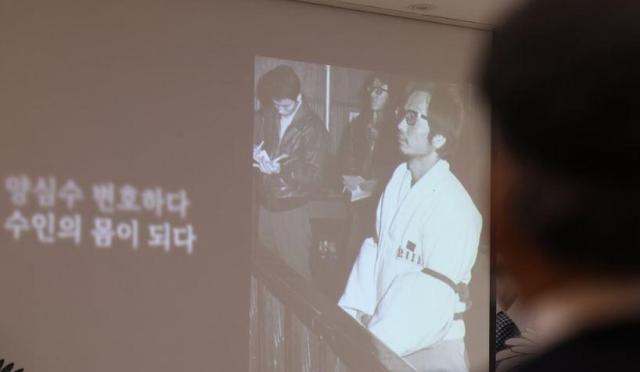
A memorial video showing the late Han Seung-heon is screened during a 2022 tribute service at Seoul St. Mary’s Hospital funeral hall in Seoul’s Seocho district. [Photo=Yonhap]