
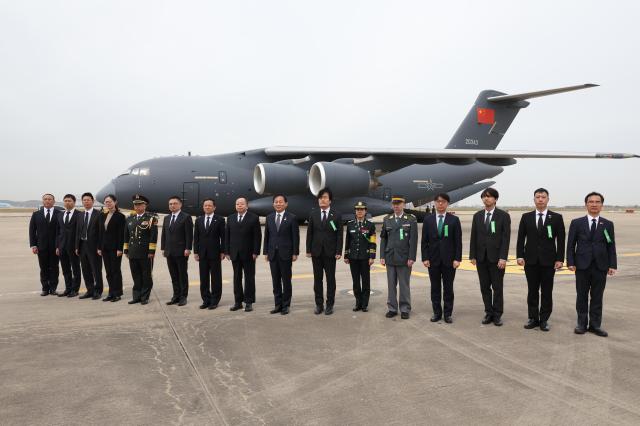
The Defense Ministry said the 13th transfer ceremony was held at Incheon International Airport, attended by Vice Defense Minister Lee Doo-hee and Xu Yao, vice minister of China’s Ministry of Veterans Affairs.
The remains of 12 Chinese soldiers were returned, bringing the total repatriated since 2014 to 1,023.
The ceremony included the signing of transfer documents, a Chinese memorial rite and the loading of the remains onto a military aircraft. China's state broadcaster CCTV said a delegation arrived in South Korea on April 19 and departed the same day with the remains aboard a Y-20B strategic transport aircraft.
Seoul had conducted the past two handovers without public ceremonies. The restoration of a formal, vice-ministerial event under the administration of President Lee Jae Myung was viewed as a gesture of goodwill.
"This handover ceremony has resumed as a public event for the first time in three years, reflecting the restoration of South Korea-China relations and the spirit of good-neighborly friendship," Lee Kwang-seok, director-general for international policy at the ministry, said. "We will continue to repatriate the remains of Chinese soldiers discovered in the future."
The Korean War, which began on June 25, 1950, and ended with an armistice on July 27, 1953, drew in a U.S.-led United Nations Command supporting South Korea and Chinese forces backing North Korea, turning the peninsula into a major Cold War battleground.
Sixteen countries sent combat troops under the UN flag. The United States deployed about 1.79 million personnel, the largest contingent, followed by the United Kingdom, Canada, Turkey, Australia and the Philippines. Others — including Thailand, the Netherlands, Colombia, Greece, New Zealand, Ethiopia, France, Belgium, South Africa and Luxembourg — also contributed forces, while several countries provided medical and humanitarian support.
China entered the war in October 1950 through the People's Volunteer Army. Chinese military deaths are estimated at between 180,000 and 400,000, though figures vary.
The conflict remains one of the deadliest since World War II, with total casualties — including civilians — estimated at up to 4 million, about 70 percent of them civilians.
Seoul said it will continue to return the remains of Chinese soldiers found on its soil in line with humanitarian principles and international law.
Copyright ⓒ Aju Press All rights reserved.
