
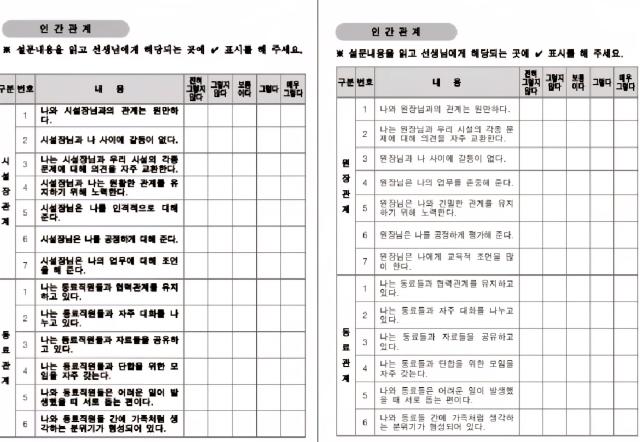
Survey pages from Democratic Party of Korea Uijeongbu mayoral preliminary candidate Kim Won-gi’s 2011 Ph.D. dissertation (left) and a Ph.D. dissertation submitted to the same graduate school a year earlier. [Photo provided by a reader]
Kim Won-gi, a Democratic Party of Korea preliminary candidate in the Uijeongbu mayoral race in Gyeonggi province, is facing allegations that he plagiarized his Ph.D. dissertation. If the claims are confirmed, they could expand into questions about his qualifications and ethics.
According to reporting by Aju Business Daily on Wednesday, Kim’s 2011 doctoral dissertation, submitted to the graduate school of Konyang University, showed a 22% plagiarism rate in the plagiarism-checking program CopyKiller Campus. While direct comparisons with standards from 15 years ago are difficult, recent practice generally treats similarity rates above 20% as grounds for failing a thesis.
Aju Business Daily said it compared the dissertation with another Ph.D. dissertation submitted to the same graduate school in 2010 and found multiple similarities under review criteria including research independence, originality of academic contribution, distinction from prior studies and whether the works are substantially identical.
The report cited structural similarities in research conditions and the flow of argument, overlap in key theories and concept definitions, repeated use of research design and analytical frameworks, and recurring phrasing and narrative style. It said the number of similar sentences and descriptions raised concerns that the overlap went beyond ordinary citation.
It also pointed to survey questions that were largely identical and to some survey items and analysis that were used in the same or similar form without separate notes or source citations.
A professor who teaches at a university in Seoul said, “Rules differ by school, but for academic journals it is generally required that the plagiarism rate be under 9%,” adding, “Even considering various circumstances, 22% appears high.”
The allegations have fueled debate in parts of academia over whether the dissertation meets the requirements of an independent study. They have also raised questions about whether political parties are adequately checking degrees and research ethics as they vet preliminary candidates for the June 3 local elections, with some warning that superficial screening could lead to repeated controversies.
Aju Business Daily said it repeatedly tried to reach Kim’s camp for comment but was unable to make contact.
According to reporting by Aju Business Daily on Wednesday, Kim’s 2011 doctoral dissertation, submitted to the graduate school of Konyang University, showed a 22% plagiarism rate in the plagiarism-checking program CopyKiller Campus. While direct comparisons with standards from 15 years ago are difficult, recent practice generally treats similarity rates above 20% as grounds for failing a thesis.
Aju Business Daily said it compared the dissertation with another Ph.D. dissertation submitted to the same graduate school in 2010 and found multiple similarities under review criteria including research independence, originality of academic contribution, distinction from prior studies and whether the works are substantially identical.
The report cited structural similarities in research conditions and the flow of argument, overlap in key theories and concept definitions, repeated use of research design and analytical frameworks, and recurring phrasing and narrative style. It said the number of similar sentences and descriptions raised concerns that the overlap went beyond ordinary citation.
It also pointed to survey questions that were largely identical and to some survey items and analysis that were used in the same or similar form without separate notes or source citations.
A professor who teaches at a university in Seoul said, “Rules differ by school, but for academic journals it is generally required that the plagiarism rate be under 9%,” adding, “Even considering various circumstances, 22% appears high.”
The allegations have fueled debate in parts of academia over whether the dissertation meets the requirements of an independent study. They have also raised questions about whether political parties are adequately checking degrees and research ethics as they vet preliminary candidates for the June 3 local elections, with some warning that superficial screening could lead to repeated controversies.
Aju Business Daily said it repeatedly tried to reach Kim’s camp for comment but was unable to make contact.
* This article has been translated by AI.
Copyright ⓒ Aju Press All rights reserved.