
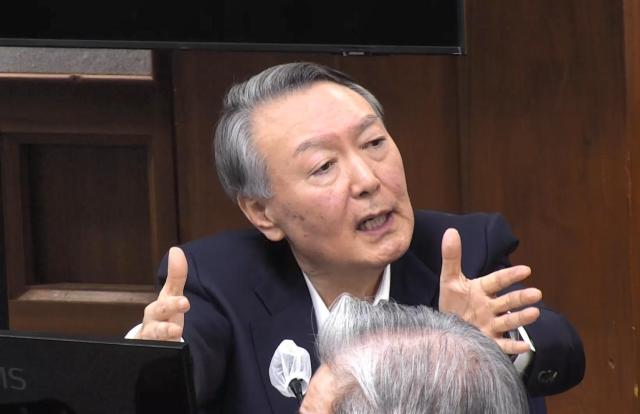
On Monday at 2 p.m., the Seoul High Court’s Criminal Division 12-1, with Judges Lee Seung-cheol, Cho Jin-gu and Kim Min-a, held the first pretrial hearing in the second trial for Yoon and seven senior military and police officials involved at the time of the martial law declaration.
A pretrial hearing is held ahead of a formal trial to organize positions and discuss plans for presenting evidence, and defendants are not required to attend. Yoon and other main defendants did not appear. Only Yoon Seung-young, former head of planning and coordination at the National Police Agency’s investigation bureau, and Mok Hyun-tae, former chief of the National Assembly security unit, attended in person.
The hearing featured a clash over defense requests for a constitutional review and the special prosecutor’s bid to add evidence.
At the outset, attorney Lee Ha-sang, who represents former Minister Kim, disclosed that the defense had filed a request for constitutional review and asked the court to suspend proceedings. Lee argued that “the current composition of the court itself is unconstitutional and unfair,” and said the trial should be paused until the Constitutional Court rules.
The panel said the request was submitted only on the 20th and it could not reach an immediate conclusion, but made clear it would not stop the proceedings on that basis. It said it would decide the constitutional issue “as soon as possible,” while proceeding with the scheduled pretrial hearing and denying Yoon’s request to change the date.
The special prosecutor’s team, including Assistant Special Prosecutor Lee Chang-gyu, appeared in force and laid out its plan for the appeal. The team said it would focus on clarifying alleged advance planning that was less clear in the first trial. It said it would use a notebook attributed to Noh Sang-won that was examined by the Supreme Prosecutors’ Office appraisal unit, along with testimony from appraisers, to argue the martial law declaration was a carefully planned insurrection.
The special prosecutor said the defense had broadly refused to consent to evidence in the first trial, citing legal misunderstandings, calling that a sign of “misunderstanding” of appellate procedure. It added it would submit additional video evidence and filings related to impeachment evidence. Seeking to prevent delays, it asked the court to move quickly, saying questioning of defendants should, if possible, be completed in a single session.
Yoon’s lawyers, however, argued the first ruling misread the facts. They said police and military movements during the deployment to the National Assembly were not aimed at insurrection, and sought to call presidential office aides as witnesses, including former senior secretary for civil affairs Kim Joo-hyun, former spokesperson Lee Do-woon and former policy chief Sung Tae-yoon, to explain the situation in detail.
On the alleged blockade of the National Assembly, the defense said it would call a series of witnesses to dispute whether there was collusion with former National Police Agency Commissioner Cho Ji-ho, including Interior and Safety Minister Lee Sang-min, Deputy Prime Minister and Economy Minister Choi Sang-mok, former Defense Security Command chief Yeo In-hyung and former third deputy director of the National Intelligence Service Baek Jong-wook. Lawyers for former Minister Kim Yong-hyun also strongly objected, arguing the indictment should be dismissed because the entity responsible for investigation and prosecution was unclear, raising possible violations of the Prosecutors’ Office Act.
The special prosecutor asked the court to reject the defense witness requests, saying the figures had already been sufficiently examined in the first trial or related impeachment proceedings and that the purpose was clearly to delay the case. The defense countered that the first ruling relied on speculation unfavorable to the defendants and that cross-examination was essential.
With the sides at odds, the panel said witness examinations on appeal are limited under criminal procedure rules to matters omitted from the first trial without gross negligence or to testimony that is indispensable. It ordered both sides to submit written explanations by next week’s morning detailing the purpose and necessity of their evidence requests.
After hearing both sides, the court said it would coordinate plans for examining evidence involving defendants including Cho and Yoon, and decide whether to admit impeachment-related evidence after reviewing filings. It then set May 7 as the first formal appellate hearing date.
* This article has been translated by AI.
Copyright ⓒ Aju Press All rights reserved.