
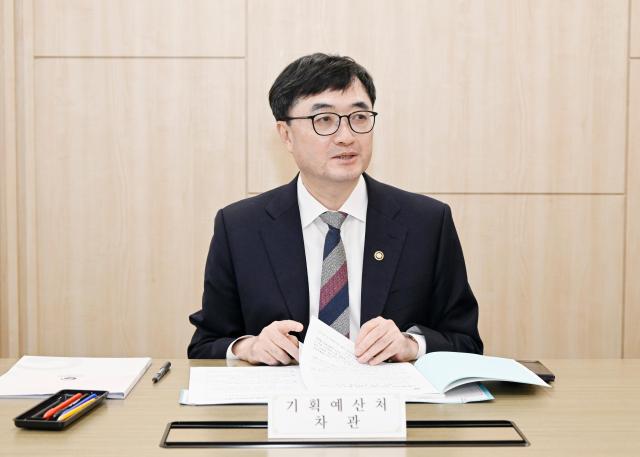
Lim Ki-geun, vice minister of the Office of Planning and Budget, delivers opening remarks while chairing the "7th fiscal execution inspection meeting" on April 6 at the Korea Federation of SMEs in Yeongdeungpo District, Seoul. [Photo=Office of Planning and Budget]
The government said it will sharply expand export voucher support to help companies cope with Middle East-related shipping disruptions and rising costs. Up to 10,900 small and midsize exporters are expected to be covered by year’s end.
Lim Ki-geun, vice minister of the Office of Planning and Budget, visited construction equipment maker Daemo Engineering in Siheung, Gyeonggi Province, on Monday to review the program’s progress and hear business concerns. The visit was arranged to assess how higher logistics costs and supply-chain uncertainty tied to the prolonged Middle East war are affecting companies.
South Korea operates export vouchers that provide bundled support for overseas expansion, from design development to logistics and marketing, to strengthen the competitiveness of smaller firms. As geopolitical instability in the Middle East has persisted and uncertainty has grown due to higher oil prices and shipping disruptions, the government has focused on easing on-the-ground difficulties, including by creating a “Middle East-specialized emergency logistics voucher.”
The export support infrastructure utilization program reviewed during the visit totals 250.2 billion won, including a supplementary budget. Demand has been strong, with about 7,050 companies applying immediately after the first recruitment notice. The government said it had executed about 80% of the 150.2 billion won in the main budget as of the end of April and plans to support up to 10,900 companies by year’s end, including 100 billion won secured through the supplementary budget.
“We will swiftly execute the existing export voucher program so the effects of fiscal support reach the field quickly,” Lim said. He said the “Middle East-specialized emergency logistics voucher” was strengthened by adding support items that reflect business needs, including costs for rerouted shipments via the Middle East, return shipping, and demurrage charges.
Lim added that, with the budget significantly expanded through the supplementary budget, the government will introduce a fast-track review system to complete beneficiary selection within one month of application to speed up support.
Lim Ki-geun, vice minister of the Office of Planning and Budget, visited construction equipment maker Daemo Engineering in Siheung, Gyeonggi Province, on Monday to review the program’s progress and hear business concerns. The visit was arranged to assess how higher logistics costs and supply-chain uncertainty tied to the prolonged Middle East war are affecting companies.
South Korea operates export vouchers that provide bundled support for overseas expansion, from design development to logistics and marketing, to strengthen the competitiveness of smaller firms. As geopolitical instability in the Middle East has persisted and uncertainty has grown due to higher oil prices and shipping disruptions, the government has focused on easing on-the-ground difficulties, including by creating a “Middle East-specialized emergency logistics voucher.”
The export support infrastructure utilization program reviewed during the visit totals 250.2 billion won, including a supplementary budget. Demand has been strong, with about 7,050 companies applying immediately after the first recruitment notice. The government said it had executed about 80% of the 150.2 billion won in the main budget as of the end of April and plans to support up to 10,900 companies by year’s end, including 100 billion won secured through the supplementary budget.
“We will swiftly execute the existing export voucher program so the effects of fiscal support reach the field quickly,” Lim said. He said the “Middle East-specialized emergency logistics voucher” was strengthened by adding support items that reflect business needs, including costs for rerouted shipments via the Middle East, return shipping, and demurrage charges.
Lim added that, with the budget significantly expanded through the supplementary budget, the government will introduce a fast-track review system to complete beneficiary selection within one month of application to speed up support.
* This article has been translated by AI.
Copyright ⓒ Aju Press All rights reserved.