

JW Pharmaceutical said April 27 it has completed dosing the last patient in a multinational Phase 3 trial of its gout treatment candidate epaminurad (URC102).
Epaminurad is an oral uricosuric drug designed to selectively inhibit hURAT1, promoting uric acid excretion. The company is developing it for hyperuricemia and gout, conditions marked by abnormally high blood uric acid levels.
JW Pharmaceutical said it has been running the Phase 3 study in five Asian countries, including South Korea, after receiving approval for the trial plan (IND) from the Ministry of Food and Drug Safety in 2022. The study was designed to compare uric-acid lowering effects and safety against the existing treatment febuxostat, and the final patient was dosed in Malaysia.
In an earlier Phase 2 trial, epaminurad met key efficacy endpoints and showed safety and tolerability, the company said. JW Pharmaceutical also said it recently secured a U.S. patent from the U.S. Patent and Trademark Office covering dosing and administration, extending U.S. exclusivity to 2038. The company plans to produce a clinical study report by the end of this year after follow-up and data analysis.
HK inno.N said April 27 it signed a joint research and development agreement with Atomatrix to develop a next-generation obesity treatment.
The partners said they will use an artificial intelligence and computer-simulation drug design platform to identify small-molecule candidates with new mechanisms intended to address limitations of incretin-based obesity drugs, including GLP-1 receptor agonists.
Under the agreement, HK inno.N will synthesize compounds and conduct biological evaluations to verify efficacy and safety, while Atomatrix will design and screen candidates using its platform, CANDDIE.
CANDDIE applies molecular dynamics-based analysis to predict not only binding stability between target proteins and candidates but also drug-response effects after binding, the companies said. HK inno.N cited its commercialization track record with the gastroesophageal reflux disease drug K-CAB and said it aims to expand competitiveness in the obesity treatment market.

SK Chemicals said April 27 it held a family volunteer program, “Norang, Spring,” bringing together seniors and employees’ families ahead of Family Month in May. The company said it is emphasizing hands-on volunteering, not only donations, as part of its social responsibility efforts.
The event was organized with the Unjeong Comprehensive Social Welfare Center in Paju and travel agency Yellow Balloon, and took place around Insadong and Jongno in central Seoul. The program paired seniors living alone with SK group employees’ families for cultural activities and an outing in the city.
About 50 people, including families from SK affiliates and seniors using the welfare center, took part, the company said. Activities included making rice cakes, visiting a museum, touring the city by bus and visiting the Cheong Wa Dae Sarangchae.
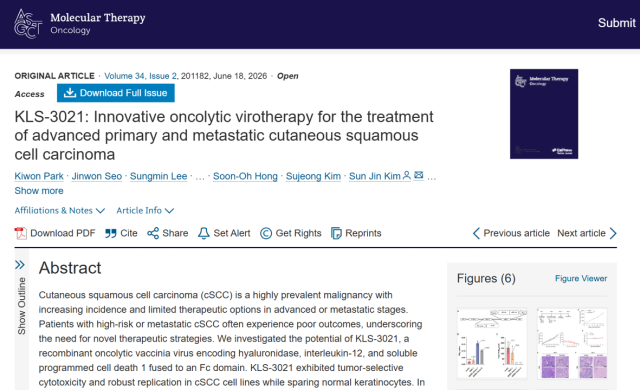
Kolon Life Science said April 27 that preclinical findings on its anticancer gene therapy candidate KLS-3021 for cutaneous squamous cell carcinoma, or cSCC, were published in the international journal Molecular Therapy Oncology (impact factor 5.3).
KLS-3021 is a candidate built on a recombinant vaccinia virus engineered for greater selectivity for cancer cells and loaded with therapeutic genes PH-20, IL-12 and sPD1-Fc. It is designed to lyse tumors, break down extracellular matrix within tumors and trigger immune responses, the company said.
In the study, KLS-3021 showed higher selective cytotoxicity and viral replication in cancer cells than in normal cells, and the virus’s ability to replicate inside tumors suggested potential for additional therapeutic effects, the company said.
In a metastatic model, viral spread was also confirmed at metastatic sites. The company said a single injection could allow the drug to circulate and target cancer cells at distant sites, raising the potential for treating metastatic cancer.
The study also observed changes in the tumor microenvironment, including hyaluronic acid degradation, increased immune-cell infiltration and immunogenic cell death, suggesting it may be able to address physical and immunological barriers at the same time, the company said.
* This article has been translated by AI.
Copyright ⓒ Aju Press All rights reserved.