

South Korea’s Science and ICT Ministry and the country’s three mobile carriers have agreed to apply a “data safety option” based on quality-of-service, or QoS, as a standard feature on low-cost plans as they negotiate measures aimed at lowering wireless bills.
According to the telecom industry on the 27th, SK Telecom, KT and LG Uplus accepted the government proposal to make QoS standard on cheaper plans as part of the ministry’s push to roll out unified LTE and 5G rate plans. The carriers were said to have little disagreement over how the unified plans would be structured, but they maintained that keeping current data allowances while cutting monthly fees by more than 10,000 won would be difficult.
The centerpiece of the overhaul is to apply QoS by default to all plans in the 20,000- to 30,000-won range so users can maintain a minimum level of data service. Under the QoS option, customers who use up their included data can continue to use unlimited data at speeds of 400 kilobits per second.
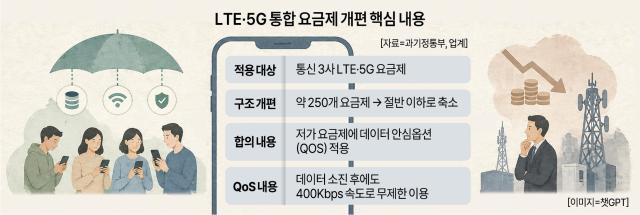
Carriers, however, are resisting proposals to lower prices while keeping data allowances unchanged. The government is said to be seeking about a 10,000-won cut per subscriber as it merges current 5G plans in the 50,000-won range with LTE plans in the 40,000-won range into unified offerings. The three carriers argue that, given network cost structures, cutting prices without reducing data would significantly damage profitability.
An industry official said all three carriers agreed with the government’s view that low-cost users should be able to access QoS without paying extra, but added that a roughly 10,000-won cut per person would be hard to accept. “Most 5G subscribers are on plans in the 50,000-won range, and offering the same data usage at prices in the 40,000-won range would be too big a loss,” the official said.
Analysts in the securities industry estimate that if the government’s price-cut plan goes ahead, the carriers’ combined operating profit could fall by 6% to 8%. They also warned that if disputes over network usage fees with global content providers such as Google are not resolved, the carriers would have limited room to offset the revenue decline. With carriers bearing most network investment costs, prolonged pressure on profitability could also affect their capacity to invest, they said.
The ministry estimates the overhaul would benefit about 7.17 million people and reduce annual telecom spending by 322.1 billion won. Industry observers said the actual impact could vary depending on the size of any price cuts and how they are applied.
A ministry official said the timing of the unified plans has not been finalized. “Additional talks are under way on several plans, and we are working to wrap things up in the first half,” the official said.
* This article has been translated by AI.
Copyright ⓒ Aju Press All rights reserved.