
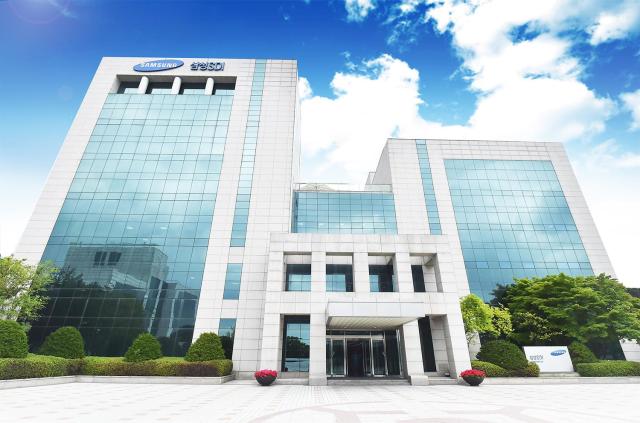
The company said in a regulatory filing on 28 that first-quarter 2026 revenue rose 12.6% from a year earlier to 3.5764 trillion won. It reported an operating loss of 155.6 billion won, narrowing the loss 64.2% year over year. Net profit totaled 56.1 billion won, returning to the black.
By business, the battery division posted revenue of 3.3544 trillion won and an operating loss of 176.6 billion won. The electronic materials division reported revenue of 222.0 billion won and operating profit of 21.0 billion won.
In batteries, demand recovered for power energy storage systems, uninterruptible power supplies, battery backup units, power tools and other applications. Revenue rose 12.5% from a year earlier and the operating loss narrowed 61.0%.
Samsung SDI said profitability improved on higher benefits from the Advanced Manufacturing Production Credit, supported by expanded U.S. production and sales of ESS batteries, and strong sales of higher-value cylindrical batteries.
In electronic materials, semiconductor-material sales remained steady, while display-material sales rebounded on higher flagship smartphone sales by major mobile customers, improving results from a year earlier.
Samsung SDI cited expanded ESS orders, diversification of customers and products in its electric-vehicle battery business, and efforts to strengthen future technology competitiveness as key drivers of the first-quarter improvement.
In ESS, it said it won new projects for prismatic LFP batteries and signed a supply contract for high-output batteries for BBUs. It also said it built a materials supply chain in advance to respond to the U.S. "prohibited foreign entity" rules.
In EV batteries, Samsung SDI said it signed a multiyear supply contract with Mercedes-Benz, securing all three of Germany’s major premium automakers as customers. It also said it won a project for tabless cylindrical batteries for hybrid electric vehicles, further diversifying its customer and product portfolio.
The company said it expects results to improve gradually from the second quarter as demand recovery continues, though it warned uncertainty in the global business environment is likely to persist.
For EV batteries, it expects demand to recover as subsidies expand in major European countries and total cost of ownership for internal-combustion vehicles rises. It said it will proceed with planned mass production for new projects without disruption and focus on restoring profitability by improving utilization rates.
For ESS batteries, Samsung SDI said it will expand local mass production and sales in the United States to meet rising demand tied to the growth of AI data centers. It also plans to participate actively in South Korea’s centralized ESS contract market and next-generation grid-linked ESS projects.
In small batteries, it said it will expand sales of differentiated products, including tabless and high-output batteries, reflecting continued growth in BBU and power-tool markets tied to increased AI data center construction and a recovery in micromobility demand.
In electronic materials, it expects demand for semiconductor and OLED materials to continue on favorable industry conditions, and said it will pursue revenue growth by expanding sales of new semiconductor patterning materials and OLED materials.
A company official said, "Uncertainty in the global business environment is expected to continue in the second quarter as well," but added, "We will execute response strategies by business segment without disruption and achieve a return to quarterly profit in the second half."
* This article has been translated by AI.
Copyright ⓒ Aju Press All rights reserved.