
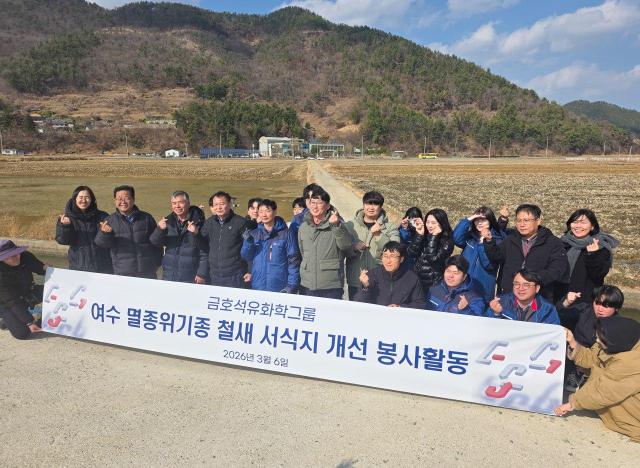
The group said April 28 it will begin a project to improve habitat for endangered migratory birds. Five affiliates will participate: Kumho Petrochemical, Kumho P&B Chemicals, Kumho Mitsui Chemicals, Kumho Polychem and Kumho T&L.
Working with Thanks Carbon, the group will invest a total of 260 million won over the next three years to create wetlands by flooding farmland near the Gasari Eco Park. The area will expand in phases, from about 1,200 pyeong in the first year to 2,400 pyeong in the second and 3,400 pyeong in the third.
The Yeosu area, near the Suncheon Bay wetland, has served as a key stopover and wintering site for migratory birds. The group said industrialization and development have reduced farmland and worsened habitat conditions. Its plan is to restore winter habitat by creating flooded rice paddies on farmland during the off-season.
Flooded paddies can support a range of species and are also known for storing carbon in soil, the group said. It plans to monitor bird numbers and environmental changes using unmanned sensor cameras and to develop management strategies based on the data.
Local farmers will take part as operators. The group said nearby farms are supplying feed such as rice seed and sweet potatoes once a week during winter. In March, Kumho Petrochemical employees joined on-site activities, it said.
Baek Jong-hoon, CEO of Kumho Petrochemical, said, “Preserving Yeosu’s ecological value and protecting biodiversity is a responsibility for a company that has grown with the local community.” He added, “We will continue sincere efforts to deepen our ESG management.”
Separately, the company said employees raised 210 plants of the Jeju native species ‘pachoil-yeop,’ a Class II endangered wild plant, for nine months and planted them near their natural habitat at the Kumho Jeju Resort.
* This article has been translated by AI.
Copyright ⓒ Aju Press All rights reserved.