
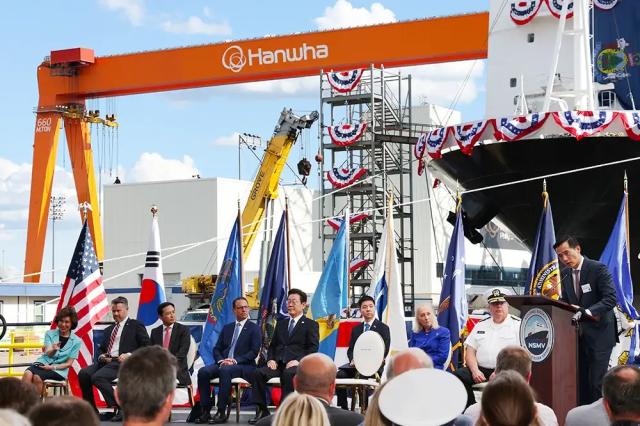
The company is accelerating efforts to develop the Philadelphia Shipyard — acquired at the end of 2024 — into a local production hub, positioning it as the centerpiece of its U.S. expansion strategy and a symbol of Korea–U.S. maritime cooperation.
Last month, its U.S. units — Hanwha Philly Shipyard and Hanwha Defense USA — signed a partnership with VARD to collaborate on the conceptual design for the U.S. Navy’s Next-Generation Logistics Ship (NGLS).
The NGLS program centers on support vessels designed to provide fuel, supplies and rearming capabilities at sea and ashore, and is widely seen as a potential entry point into the U.S. defense market.
The regulatory environment, however, remains tightly controlled.
U.S. shipbuilding is protected by laws such as the Jones Act and the Byrnes-Tollefson Amendment, which effectively bar foreign shipyards from direct participation in commercial and naval vessel construction.
Hanwha’s acquisition of a U.S.-based yard allows it to bypass geographic restrictions, but “Buy American” rules continue to limit participation in major combat programs such as destroyers and aircraft carriers.
“Hanwha’s entry into the NGLS program was possible because auxiliary ships require relatively lower security clearance,” an industry official said. “The real challenge lies in combatant vessels.”
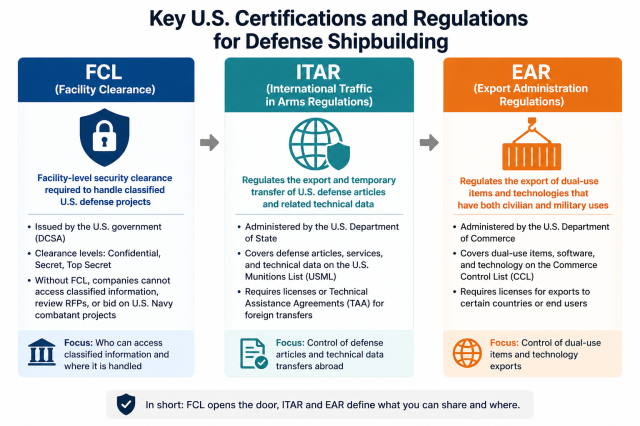
The FCL system determines eligibility to access classified U.S. government information, with levels ranging from Confidential to Top Secret. Without certification, companies cannot review even basic bidding documents, effectively excluding them from construction, maintenance, repair and overhaul of U.S. Navy combat ships.
No South Korean shipbuilder has secured FCL to date, industry sources said.
Even if obtained, clearance would mark only the first step.
Hanwha would still need to navigate strict export controls under the International Traffic in Arms Regulations and the Export Administration Regulations, which limit the transfer of sensitive defense technologies — even to foreign-owned firms operating in the U.S.
That poses a challenge to Hanwha’s ambition to integrate advanced Korean naval design capabilities, including work from the KDDX destroyer project, into the Philadelphia yard. Such transfers would require Technical Assistance Agreements and case-by-case export licenses from the U.S. State Department.
“The process is inherently complex, especially given foreign ownership,” said Jang Won-joon, a defense engineering professor at Jeonbuk National University. “It is expected to take time.”
The FCL process typically takes between one and five years, depending on security reviews and ownership structure.
Hanwha aims to scale the Philadelphia facility into a manufacturing hub capable of producing up to 20 vessels annually, though the timeline will depend on regulatory approvals and existing order backlogs.
“Philly Shipyard already has a backlog of previously ordered vessels,” a Hanwha Ocean official said. “Our priority is to expedite deliveries and enhance productivity, while pursuing FCL in line with capacity expansion and future contract opportunities.”
Financially, the company appears well-positioned to sustain the push. Hanwha reported 1.07 trillion won ($1.17 billion) in cash and cash equivalents at the end of March, alongside a 71 percent jump in first-quarter operating profit to 441.1 billion won.
Still, industry observers caution that without overcoming technology transfer barriers, the shipyard’s expansion may fall short of the high-tech integration envisioned under the MASGA initiative.

Copyright ⓒ Aju Press All rights reserved.
