
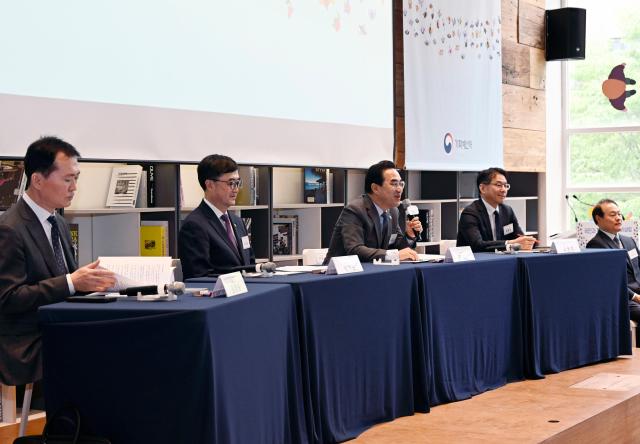
Planning and Budget Minister Park Hong-geun chairs a ‘Public Finances With the People’ town hall meeting on April 28 at Community House Masil in Seoul’s Jung District. [Photo=Ministry of Planning and Budget]
Fiscal authorities on April 28 held a town hall-style meeting to discuss how the nation’s finances are managed and to gather public input.
The event, hosted by the Ministry of Planning and Budget, was its first public forum aimed at collecting citizens’ views directly on fiscal policy. After a topic presentation, all participants were invited to speak freely and take part in a question-and-answer session.
Park said he has long wrestled with “how to bring budgets and public finances closer to people’s lives,” calling the meeting “a first step” toward finding answers.
He set out three goals for future fiscal management: public finances “owned by the people,” management proven by results, and responsible finances that earn trust.
Park said he would “dramatically” expand autonomy in budget drafting while making the process transparent and taking responsibility for outcomes. He said the government would build a sound fiscal foundation that passes hope to future generations by ensuring money is spent where it is needed.
In the open discussion, participants raised issues including fiscal sustainability for future generations, the role of public finances in a mid- to long-term vision, expanding public participation and communication, and operating performance evaluations that citizens can feel and assess.
Many members of the public called for stronger support for young people and budget planning that improves the efficiency of fiscal spending. Some also voiced concerns that supplementary budgets could push up prices and increase burdens on future generations.
Park said he shared participants’ concerns. On worries about national debt, he said an active fiscal role is important to support livelihoods and create growth momentum, while also maintaining vigilance on sustainability through restructuring “unnecessary and non-urgent” spending.
He added that the core of “people’s sovereignty” in public finances is enabling citizens to feel they are the owners of the budget, and said the criticism and ideas offered would be reflected in future budget drafting and policy planning.
The ministry said it will continue outreach with the public, including on a mid- to long-term national development strategy and improving the efficiency of fiscal spending.
The event, hosted by the Ministry of Planning and Budget, was its first public forum aimed at collecting citizens’ views directly on fiscal policy. After a topic presentation, all participants were invited to speak freely and take part in a question-and-answer session.
Park said he has long wrestled with “how to bring budgets and public finances closer to people’s lives,” calling the meeting “a first step” toward finding answers.
He set out three goals for future fiscal management: public finances “owned by the people,” management proven by results, and responsible finances that earn trust.
Park said he would “dramatically” expand autonomy in budget drafting while making the process transparent and taking responsibility for outcomes. He said the government would build a sound fiscal foundation that passes hope to future generations by ensuring money is spent where it is needed.
In the open discussion, participants raised issues including fiscal sustainability for future generations, the role of public finances in a mid- to long-term vision, expanding public participation and communication, and operating performance evaluations that citizens can feel and assess.
Many members of the public called for stronger support for young people and budget planning that improves the efficiency of fiscal spending. Some also voiced concerns that supplementary budgets could push up prices and increase burdens on future generations.
Park said he shared participants’ concerns. On worries about national debt, he said an active fiscal role is important to support livelihoods and create growth momentum, while also maintaining vigilance on sustainability through restructuring “unnecessary and non-urgent” spending.
He added that the core of “people’s sovereignty” in public finances is enabling citizens to feel they are the owners of the budget, and said the criticism and ideas offered would be reflected in future budget drafting and policy planning.
The ministry said it will continue outreach with the public, including on a mid- to long-term national development strategy and improving the efficiency of fiscal spending.
* This article has been translated by AI.
Copyright ⓒ Aju Press All rights reserved.