
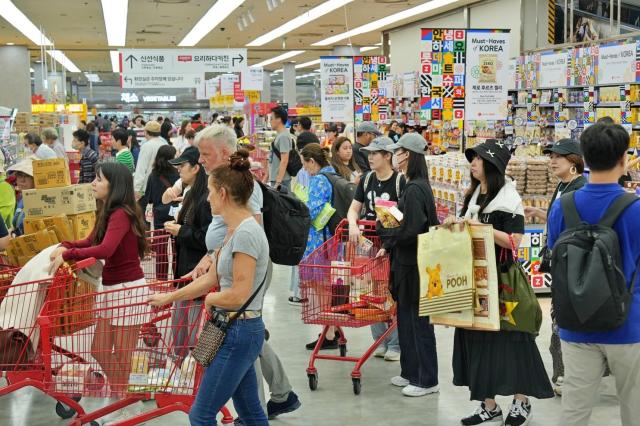
From late April through early May, South Korea’s retail and travel industries are gearing up for a three-nation holiday rush as extended breaks in Korea, China and Japan overlap. Japan’s Golden Week (April 29-May 6) and the Labor Day holidays in China and Taiwan (May 1-5) begin at the same time this week, prompting companies to step up efforts to attract visitors to Korea.
The Ministry of Culture, Sports and Tourism and the Korea Tourism Organization said April 28 they expect 80,000 to 90,000 Japanese tourists and 100,000 to 110,000 Chinese tourists to visit Korea during the holiday period.
In the first quarter, arrivals from Japan and China totaled 940,000 and 1.45 million, respectively, the highest levels on record.
Korea is also expected to see stronger domestic travel and shopping demand, with a string of holidays running from Labor Day on May 1 — designated a statutory holiday for the first time this year — through Children’s Day on May 5.
The influx of Japanese and Chinese visitors is also being watched for its potential to lift second-quarter retail conditions. The Korea Chamber of Commerce and Industry previously forecast a subdued outlook, with its 2026 second-quarter Retail Business Survey Index at 80, little changed from 79 in the prior quarter, citing Middle East-driven geopolitical risks and prolonged high inflation, a weak won and high interest rates as constraints on domestic demand.
Industry expectations have picked up, however, as the Korea-China-Japan holiday overlap coincides with the phased rollout of the government’s “high oil price damage relief payments,” which could add to consumer spending power.
Department stores and duty-free shops are rolling out promotions aimed at foreign shoppers, including discount coupons and point rewards. Big-box retailers are expanding K-food promotions — a staple on many visitors’ shopping lists — and adding more convenient payment benefits to encourage spending.
Restaurants, convenience stores and other offline retailers are also preparing broad discount events and securing inventory, betting that relief-payment spending will translate into stronger purchasing power in neighborhood commercial districts.
“By capturing both foreign tourist demand and domestic demand boosted by the oil-price relief payments, the industry could move beyond simply protecting second-quarter results and deliver a meaningful rebound,” an industry official said.
* This article has been translated by AI.
Copyright ⓒ Aju Press All rights reserved.