
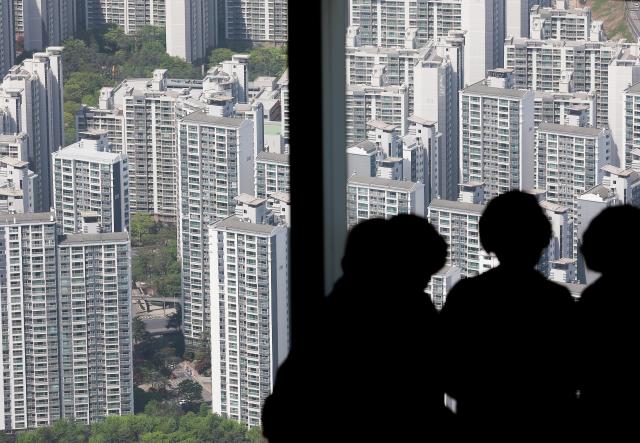
With the deadline 10 days away for the end of a temporary suspension of heavier capital gains taxes on home sales, Seoul’s apartment market is showing a sharper split in how quickly listings are being cleared. In the Han River belt and outer districts, bargain-priced homes are being snapped up by end users, while transactions in the Gangnam area have largely stalled.
According to the real estate big-data platform Asil, Seoul had 72,699 apartment listings as of the previous day. That is down for six straight weeks from a peak of 80,080 in the third week of March (March 16-22), meaning about 9.22% of total listings were sold or pulled from the market in roughly a month.
The decline has been led by outer and midpriced areas. Listings fell by double digits in several districts, including Jungnang (-16.9%), Nowon and Gangbuk (each -13.4%), Guro (-12.9%), Dongjak (-11.5%) and Seongdong (-11.1%). The drop was attributed to newlyweds and first-time buyers, strained by the rental market, purchasing quick-sale homes mainly in the 600 million won to 1 billion won range.
Gangnam has moved in the opposite direction. With land-transaction permit rules, tighter lending and owner-occupancy requirements combining to curb demand, the area remains in what the market calls a “transaction cliff,” where listings accumulate but deals do not follow.
The gap is clearer in absorption rates. Using Ministry of Land, Infrastructure and Transport transaction data and Asil figures, the absorption rate in March for seven Han River belt districts — including Seongdong, Mapo, Yeongdeungpo, Dongjak and Yangcheon — was 36.9%, about 2.2 times the 16.6% recorded in four core districts: Gangnam, Seocho, Songpa and Yongsan.
By district, Yangcheon saw 54.4% of new listings traded within the month, while Seocho recorded 7.3%. Yeongdeungpo (50.7%), Mapo (46.3%) and Dongjak (44.0%) also posted high absorption rates.
Analysts attributed the polarization to differences in price levels and regulation. Major complexes in the Han River belt have median prices of 1 billion won to 1.3 billion won, limiting the impact of lending rules, while Gangnam’s 3 billion won to 4 billion won price range narrows the buyer pool. Owner-occupancy requirements have also raised barriers to entry.
Inventory turnover showed the same pattern. In March, the Han River belt’s turnover rate was 7.22%, about 3.1 times the 2.31% rate in the four core districts, suggesting a faster “circulating” market outside Gangnam and a more stagnant one in the south.
Even so, prices in Gangnam have not fallen much despite weak trading, and some complexes have shown signs of a slight rebound.
Song Seung-hyeon, head of City and Economy, said, “For the government’s supply-inducing policies to work evenly across Seoul, a differentiated approach tailored to local supply and demand conditions is needed rather than uniform regulation.” He added, “The outer districts need expanded supply, while Gangnam needs measures to ease transaction bottlenecks.”
* This article has been translated by AI.
Copyright ⓒ Aju Press All rights reserved.