

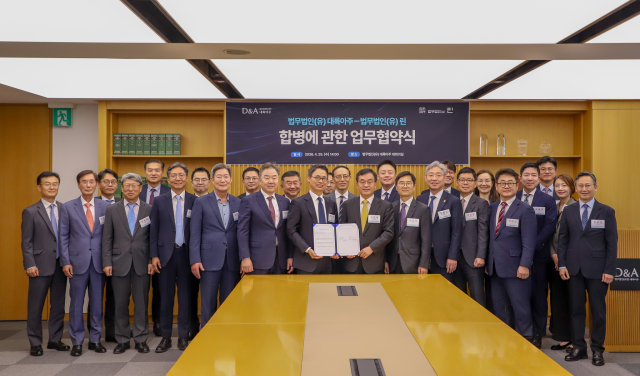
Daeryuk & Aju and Lin said they will merge, saying mid-sized firms face structural limits in moving into the top ranks of South Korea’s legal market.
Lee Gyu-cheol, managing partner at Daeryuk & Aju, said in an interview after the firms signed a merger memorandum of understanding on the 29th that “in the current law firm market structure, it is virtually impossible for a mid-sized firm to rise into the top tier through organic growth alone.”
He described the gap in scale: “If a top firm grows 10%, that’s an additional 10 billion won, but for a mid-sized firm it’s only 1 billion won,” he said, adding that “under this structure, it’s hard to narrow the gap.” Lee said Daeryuk & Aju, which he described as remaining in “Tier 2,” saw a risk of stagnating or falling behind.
That assessment led to the merger push. “There are limits to recruiting individual talent, so we had no choice but to choose a merger,” Lee said. “I think this decision is our last big bet.”
Lim Jin-seok, managing partner at Lin, voiced a similar view, focusing on practical constraints. “At the level of a mid-tier firm, there are clear limits to the size of cases and deals you can handle,” he said, adding that “for some large matters, the structure makes it difficult even to apply.” Lim said Lin concluded it had reached a “ceiling” at its current size.
He pointed to barriers to entry. “First-tier financial institutions such as banks, and major fair-trade cases, move around the Big 6 firms,” Lim said. “Even with capability, if you’re small, you often aren’t included among the options.”
Lim said Lin pursued a merger not for simple expansion but for a “tier jump.” He said Daeryuk & Aju was “the most proactive” and best-aligned partner among firms Lin contacted.
Both firms said the post-merger strategy will focus on “synergy.”
“A merger matters only if 1 plus 1 becomes 3, not 2,” Lim said. “If we secure scale and a brand, we can compete 충분히 with top firms.”
Lee said the next task will be improving revenue per lawyer. He said the merger should broaden the range of matters the combined firm can take on.
The firms plan to combine Daeryuk & Aju’s strengths in litigation and criminal matters with Lin’s strengths in corporate advisory work and mergers and acquisitions, aiming to build a “one-stop service” system.
Lim said Lin has been relatively weaker in criminal work, sometimes leaving it unable to handle related matters for corporate clients in-house. After the merger, he said, the firm expects to respond to clients’ criminal, litigation and advisory needs under one roof.
Lee said the firms will also prepare for risks that can come with a large merger. “Conflicts of interest can inevitably arise during the merger process, but we can minimize them through 충분한 discussion,” he said. “What matters is that the number of matters we can handle increases.”
On differences in organizational culture, Lee said Lin has many lawyers who previously worked at large firms, adding that there is “a lot to learn.” He said the firms plan to integrate through collaboration and personnel exchanges.
Lim said “the most important thing in a merger is will,” adding that the goal is to grow the firm and have its members prosper together.
Both also addressed artificial intelligence. Lee said it would be difficult to generate direct revenue from AI and that it would mainly be used to improve efficiency. He said reducing costs and raising productivity will shape competitiveness. Lim said AI is a variable affecting the entire legal industry and warned that firms that fail to prepare could be left behind.
The merger process is at an early stage. The firms said they have formed a merger promotion committee to discuss the combined firm’s name and decision-making structure, with a goal of filing merger registration in October.
“Today’s agreement is only a starting point,” Lee said, stressing the need to create synergy by combining strengths. He said the long-term goal is to reach more than 200 billion won in revenue.
Lim said the merger would create a foundation to compete with top firms, adding that the combined firm would now have the conditions to compete head-on on the same stage.
* This article has been translated by AI.
Copyright ⓒ Aju Press All rights reserved.