
As the Kospi extends its gains, overseas investors are increasing demand for South Korea-listed exchange-traded funds.
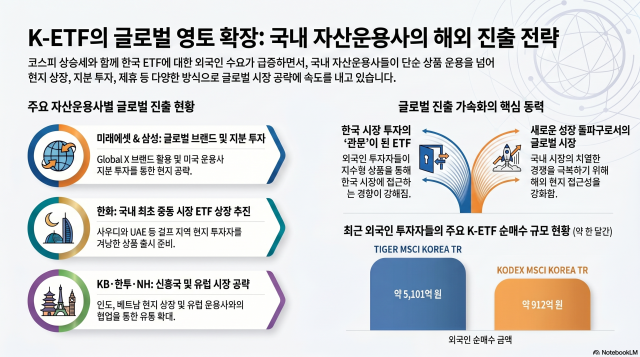
According to the Korea Exchange on April 29, foreign investors bought about 510.1 billion won of the TIGER MSCI KOREA TR from March 27 through that day. They also posted net purchases of 91.2 billion won in the similarly structured KODEX MSCI KOREA TR.
Korean asset managers are moving beyond basic product management and accelerating efforts to tap overseas ETF markets through local listings, equity investments and strategic partnerships. The U.S., the Middle East and India are key targets.
Hanwha Asset Management is seeking to become the first Korean manager to list an ETF in the Middle East, aiming to capture new demand. It is preparing products for local investors, focusing on Gulf markets such as Saudi Arabia and the United Arab Emirates.
Mirae Asset Management operates ETFs in major markets including the United States, Canada, Australia and Japan under its Global X brand. Its overseas ETF net assets account for more than half of its total, reflecting progress in its global business.
Samsung Asset Management has taken a 20% stake in U.S. ETF manager Amplify, seeking to broaden its reach by listing ETF strategies proven in Korea in the local market. KB Asset Management launched what it said was the first Korea-listed ETF focused on India’s digital industry, while NH-Amundi Asset Management is expanding ETF distribution in Europe through cooperation with global manager Amundi. Korea Investment Trust Management has also listed an ETF in Vietnam and has posted strong profitability, the report said.
Industry officials say the rapid growth of Korea’s ETF market has built management capabilities that are now aligning with overseas demand. “As competition in domestic ETFs intensifies, global markets are emerging as a new growth breakthrough,” an asset management industry official said. “Overseas expansion that combines local listings and strategic partnerships will expand further.”
Analysts also link the trend to changes in how global money flows into Korea. As overseas investors increasingly access the Korean market through index products rather than individual stocks, ETFs are effectively becoming a gateway for investing in Korea. In response, managers are stepping up strategies to improve access by pursuing local exchange listings and building global brands, rather than relying only on products listed in Korea.
* This article has been translated by AI.
Copyright ⓒ Aju Press All rights reserved.