
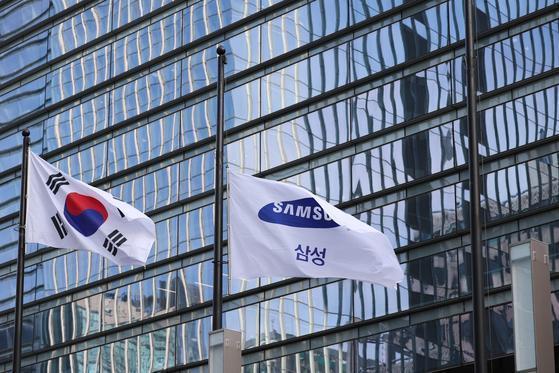
Samsung Electronics said its semiconductor business generated about 54 trillion won in operating profit in the first quarter, far exceeding the company’s total operating profit for all of last year.
In its final earnings release on Wednesday, Samsung said its Device Solutions (DS) division posted revenue of 81.7 trillion won and operating profit of 53.7 trillion won. Results surged as the spread of artificial intelligence boosted demand for high-value memory chips and prices rose.
Revenue from its finished-goods businesses totaled 52.7 trillion won, with operating profit of 3 trillion won. The Mobile eXperience (MX) unit grew on stronger flagship sales, including the Galaxy S26 Ultra, but profit gains were limited by higher costs and tariff burdens.
Samsung said the widening gap between business units is likely to persist. It expects the semiconductor business to continue leading companywide results this year as memory prices keep rising and supply-demand imbalances deepen. The company also expects high-bandwidth memory (HBM) sales to climb sharply.
On a first-quarter earnings conference call, Samsung said, “The situation where memory supply fails to keep up with demand is expected to continue into next year,” adding that the supply gap versus demand next year could widen further than this year even on those demand drivers alone.
Samsung said it expects HBM sales this year to rise to more than three times last year’s level. It said HBM4 began mass-production shipments in February, the first in the world, and capacity expansion is proceeding as planned, with supply set to ramp up in the second half. Samsung added that HBM4 revenue is expected to exceed half of total HBM revenue starting in the third quarter and to account for a majority of full-year HBM sales.
By contrast, Samsung said profitability at its Device eXperience (DX) division — which includes mobile, home appliances and TVs — is likely to weaken. “Due to factors such as rising component costs, a year-on-year decline in profitability for the MX business is unavoidable,” the company said. It added that securing performance and profitability in the TV market this year will be difficult amid higher raw material prices and an uncertain external business environment.
Samsung said it plans a broader reshaping of its DX business under a “select and focus” strategy. It said it has withdrawn from sales in China’s TV and home-appliance markets and is reviewing outsourcing production for some low-margin appliance product lines. Samsung said it will pursue “fundamental improvements” through cost reductions, structural efficiency and stronger long-term organizational competitiveness, and will also focus on securing future growth engines through mergers and acquisitions.
Samsung also said it will significantly increase semiconductor-related facility investment to meet AI-driven demand. “With continued AI demand this year, capex is expected to increase to a considerable level compared with last year,” it said, adding it will expand early-stage R&D investment in next-generation processes and core technologies to secure technology leadership. Samsung said memory investment fell from the previous quarter after it front-loaded spending late last year, including adding new cleanroom space at its Pyeongtaek campus, but investment is expected to rise this year as equipment is installed in that space, lifting overall capex substantially.
* This article has been translated by AI.
Copyright ⓒ Aju Press All rights reserved.