
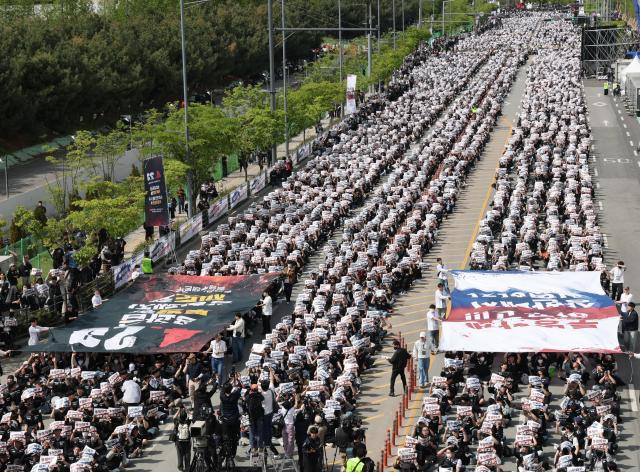
The South Korean tech giant, now ranked among the world’s largest technology companies alongside Apple, Microsoft and Nvidia by market value and profit scale, posted an all-time quarterly operating profit of 57.2 trillion won ($41 billion) for the January-March period.
But the numbers exposed an increasingly fractured company: the semiconductor division generated nearly all of the earnings windfall, while workers in smartphones, TVs and appliances braced for restructuring and possible layoffs.
The widening imbalance has now spilled into open labor conflict.
Samsung’s majority union, dominated by semiconductor workers in the Device Solutions (DS) division, is threatening a general strike while demanding uncapped bonuses equivalent to 15 percent of divisional operating profit.
The union argues that engineers and production staff behind the company’s AI memory boom deserve unprecedented compensation after helping Samsung capitalize on soaring demand for high-bandwidth memory (HBM) chips used in AI data centers.
Yet the aggressive push has triggered backlash from employees outside the semiconductor business, particularly in the Device eXperience (DX) division that oversees smartphones, TVs and home appliances.
According to industry officials Sunday, requests to withdraw from the union have surged in recent days, with internal bulletin boards flooded with resignation posts and criticism that the labor group has effectively become a “chip workers’ union” rather than a companywide representative body.
Daily withdrawal requests reportedly jumped from fewer than 100 to more than 1,000 at one point last week.
The anger intensified after the union announced it would provide up to 3 million won in strike activity payments for staff participating more than 15 days in labor action, following an earlier decision to raise monthly union fees fivefold during collective bargaining.
Non-chip employees accuse union leadership of using broader membership dues to finance a strike agenda centered almost entirely on semiconductor workers.
“They only talk about DS bonuses while DX employees are worried about survival,” one employee wrote on an internal forum.
The contrast between Samsung’s two core businesses has become increasingly stark under the AI-driven semiconductor supercycle.
The DS division posted 53.7 trillion won in operating profit in the first quarter alone, nearly 50 times higher than a year earlier, driven by explosive demand for AI memory chips and continued price increases across the memory market.
Industry estimates suggest DS operating margins reached roughly 66 percent, with memory profitability approaching 75 percent.
Under the union’s proposal, some semiconductor employees could theoretically receive bonuses approaching 600 million won per person this year if Samsung’s annual earnings continue at the current pace.
Meanwhile, the DX division generated only 3 trillion won in quarterly operating profit, down 36 percent from a year earlier despite the launch boost from the Galaxy S26 smartphone lineup.
Profit margins in the consumer electronics business have collapsed to around 6 percent as rising semiconductor costs, weaker global demand and U.S. tariff pressures squeeze earnings.
Some analysts are even warning that Samsung’s consumer electronics operation could slip into annual losses for the first time.

The labor dispute is now exposing a deeper structural issue inside Samsung: the company increasingly resembles two vastly different businesses operating under one corporate roof.
One side is riding the global AI infrastructure boom and generating historic profits. The other is struggling with slowing demand, margin compression and fears of restructuring.
Industry observers say the internal division carries broader implications for Samsung’s long-term cohesion.
“For years, profits from smartphones and appliances helped sustain semiconductor investment during downturns,” an employee said, requesting anonymity. “Now the roles have reversed, but employees are questioning whether the rewards and burdens are being shared fairly.”
Samsung management has so far resisted the union’s demand to remove bonus caps, partly out of concern that extreme compensation gaps could deepen resentment across divisions.
But the conflict is becoming harder to contain as the semiconductor boom reshapes internal power dynamics inside South Korea’s most important company.
Even within the chip division itself, tensions are reportedly intensifying between union members and non-members as the prospect of a walkout approaches.
“People barely talk to each other anymore depending on whether they support the union,” another Samsung employee said. “Everyone says we are one company, but right now it doesn’t feel that way.”
Copyright ⓒ Aju Press All rights reserved.
