
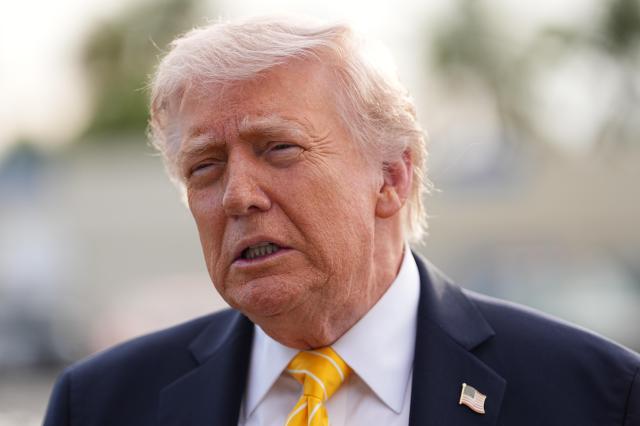
President Donald Trump is escalating pressure on the European Union, pairing a threat to raise auto tariffs with a push to cut U.S. forces stationed in Germany. The moves come after Europe was seen as uncooperative with U.S. military operations against Iran, sharpening strains within the trans-Atlantic alliance.
CNN reported that Trump told reporters in Florida on Friday, before boarding Air Force One, that the United States would “reduce troops significantly,” adding that the cut would be “far more” than 5,000. His remarks came less than a day after the Pentagon said it would withdraw about 5,000 troops from Germany over the next six to 12 months.
Trump had also signaled possible reductions earlier in the week, after German Chancellor Friedrich Merz said the United States was being “humiliated” in ceasefire talks with Iran.
A senior U.S. Defense Department official, speaking on condition of anonymity, told Reuters that Merz’s comment was “inappropriate and unhelpful,” and said Trump was responding “legitimately” to remarks that backfired.
German officials have reacted calmly. Defense Minister Boris Pistorius told dpa that a U.S. troop drawdown in Europe, including Germany, was foreseeable and that Europeans must take more responsibility for their own security.
The Wall Street Journal reported that while the German government has played down the withdrawal as largely symbolic, experts warned a wider rupture could threaten both Europe’s economy and its security.
Thorsten Benner, director of the Berlin-based Global Public Policy Institute, said the issues at stake were “far more important” than a symbolic 5,000-troop cut. He also pointed to concerns that U.S. weapons stocks are being depleted quickly after heavy use of military assets in the Iran war.
More than 36,000 U.S. troops are stationed in Germany. Ramstein Air Base hosts the headquarters of U.S. Air Forces in Europe and supports airlift, airdrop and aeromedical evacuation units. Germany also hosts NATO-related facilities.
Concerns have also surfaced in the United States. U.S. Army Lt. Gen. Gordon Davis, a former senior NATO official, said congressional reaction suggests the announcement was made without sufficient coordination and could affect NATO deterrence. He said it could also weaken the U.S. ability to respond quickly to conflicts in Europe or nearby regions.
Whether the reductions will be carried out remains unclear. Congress has previously moved to constrain troop cuts in Europe. In 2020, during Trump’s first administration, he sought to reduce forces in Germany by about 12,000, but the plan was effectively blocked after Congress imposed conditions through the National Defense Authorization Act.
Trump is also wielding tariffs. On May 1, he said the EU had failed to implement the “Turnberry agreement,” a trade deal reached at a golf resort in Turnberry, Scotland, and said he would raise tariffs on cars and trucks imported from the EU to 25% next week.
That would restore tariffs to levels that existed before a trade agreement reached on July 27 last year. Under that deal, the EU agreed to buy $750 billion in U.S. energy and military equipment and to make an additional $600 billion in investment. In return, the United States lowered its reciprocal tariff rate to 15% and set product-specific tariffs, including on autos, at 15%.
Moritz Schularick, president of the Kiel Institute for the World Economy, told Reuters that raising the auto tariff to 25% could cost Germany about 15 billion euros, and could rise to 30 billion euros over the longer term. The institute did not disclose its calculation method.
Volkswagen Group, which accounts for about 40% of German auto production, has said that even at a 15% tariff it faces about 4 billion euros a year in added costs. Mercedes-Benz and BMW, with higher shares of U.S.-based production, are expected to be less affected.
* This article has been translated by AI.
Copyright ⓒ Aju Press All rights reserved.