
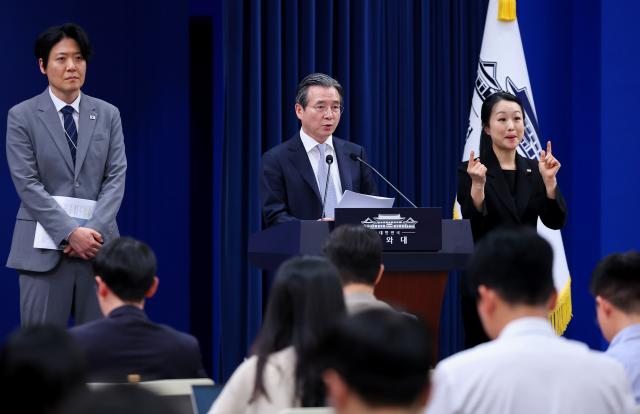
Speaking at a news briefing at Cheong Wa Dae, Kim addressed a bill by Progressive Party lawmaker Yoon Jong-oh that would abolish the deduction entirely. Kim said the government is only considering adjustments and that claims it would reduce owner-occupancy are “not true at all.”
Kim added, however, that officials need to consider whether applying the same 40% deduction rate to both residence and holding periods fits the goal of reshaping the housing market around owner-occupiers.
“If the system is reorganized around actual residence, there may be cases worth considering for non-residence, but we need to gather more opinions,” he said, stressing that the government will do its best to ensure there are no problems protecting owner-occupiers with a single home.
The long-term holding special deduction reduces taxes on gains from selling real estate held for at least three years, with the deduction rising with the holding period. For example, selling a single home held and lived in for at least 10 years can qualify for a 40% holding-period deduction and a 40% residence-period deduction, making 80% of the capital gain tax-exempt.
Last month, President Lee wrote on X, formerly Twitter, that “normalizing the abnormal practice of cutting taxes for people who speculated for a long time on homes they don’t live in” is not a “tax bomb.” He said that to properly protect single-home owners, it would be right to reduce tax breaks tied to non-resident holding periods and increase breaks tied to resident holding periods.
Kim said Lee had signaled plans to rationalize the tax system by differentiating among categories such as multiple-home owners, non-residents and ultra-high-priced homes, and that ministries and related organizations are studying options.
Kim also said the presidential office believes the deferral of heavier capital gains taxes on multiple-home owners — set to expire May 9 — helped bring more homes to market and contributed to price declines in premium apartment areas such as Seoul’s Gangnam district.
He said listings increased after the government announced it would end the deferral, and prices fell particularly in high-priced apartment areas including Gangnam’s three districts and Yongsan.
Kim said that since Jan. 23, sale listings in the three Gangnam districts and Yongsan have risen about 46%, and price gains have turned into declines. He called it a meaningful change that high-end apartment areas fell first, an unusual pattern that also matters in terms of easing asset inequality.
He said sales of Seoul apartments held by multiple-home owners in March rose 32% from a year earlier, and 73% of buyers were people without homes. He said it was also positive that transactions were centered on end-users such as young people.
Looking ahead, Kim said some decline in listings is inevitable after the deferral ends, but he argued the same pattern seen in 2021 is unlikely to repeat because strong measures such as lending rules and the land transaction permit system are already in place.
On the government’s pledged plan to supply 60,000 housing units, Kim said it will begin as announced.
* This article has been translated by AI.
Copyright ⓒ Aju Press All rights reserved.