
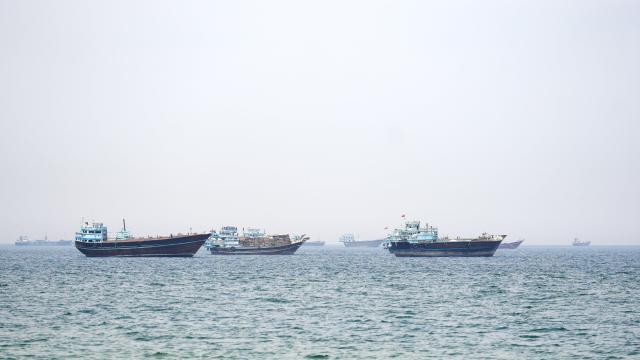
According to Yonhap on Monday, the IRGC set a new western control line running straight from the western tip of Iran’s Qeshm Island to Umm Al Quwain in the United Arab Emirates. On the southeastern side, at the strait’s entrance, it drew a control line from Mount Mobarak in southeastern Iran to a point south of Fujairah in the UAE.
Previously, the IRGC designated waters near Qeshm and the nearby Larak Island as a safe route, while labeling the waters that curve around Oman’s Musandam Peninsula as a “danger zone” and restricting ship movements there.
Under the newly disclosed lines carried by Iranian media, the IRGC’s control zone now extends across both sides of the strait, covering not only Omani waters but also parts of UAE territorial waters. The UAE’s port of Fujairah, outside the strait and previously a potential way to bypass a blockade, is also included in the declared control area.
The move came after U.S. President Donald Trump said he would launch “Project Freedom” starting Monday morning to support passage through the Strait of Hormuz. The IRGC responded by declaring broader and tougher control, signaling it could treat any attempt to pass under U.S. naval escort as an “intrusion” into its control zone and use force.
Shipping industry officials said that if the restrictions are enforced in earnest, freight rates tied to a “Hormuz premium” could surge again. The term refers to additional price increases as geopolitical risk in the strait is directly reflected in global oil prices.
Amid the recent rise in regional tensions, war-risk insurance premiums for ships transiting the strait have jumped to as much as more than 10 times normal levels, rising from about 0.25% of a vessel’s value to as high as 1% to 3%.
* This article has been translated by AI.
Copyright ⓒ Aju Press All rights reserved.