

Foreign brokerages and South Korean securities firms are expanding “integrated accounts” that let foreign retail investors trade Korean stocks without opening separate local accounts. After regulatory changes, major firms have moved quickly, with nine companies having launched services or reviewing plans. With the domestic market posting an unprecedented rally, the industry expects additional support from foreign inflows.
According to the financial investment industry on Tuesday, Samsung Securities is preparing to formally launch an integrated account service in partnership with global online brokerage Interactive Brokers (IBKR). It is currently running a pilot program for U.S. investors. IBKR provides access to more than 150 markets worldwide and has about 4.6 million accounts.
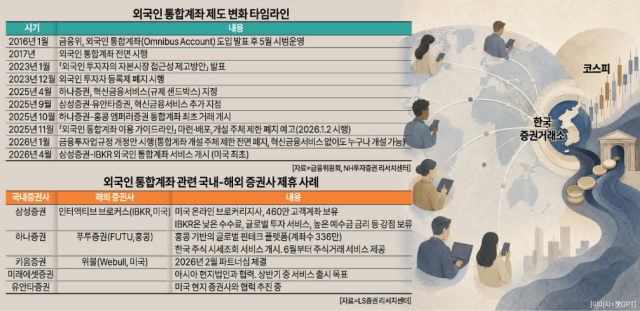
Hana Securities began offering the service in October last year, the first among Korean brokerages, through a partnership with Hong Kong’s Emperor Securities. Since March, it has also provided the service with Japan’s Capital Partners, and it plans to launch it with Hong Kong’s Futu Securities starting in June. Futu has about 3.36 million accounts.
Kiwoom Securities also signed a partnership in February with U.S. online brokerage Webull and is preparing an integrated account service. Mirae Asset Securities, KB Securities, NH Investment & Securities, Yuanta Securities, Meritz Securities and Shinhan Investment are also said to be reviewing launches.
Under the integrated account model, an overseas brokerage opens an account at a Korean securities firm in its own name, then aggregates multiple investors’ orders for trading and settlement. The key point is that foreign retail investors can buy and sell Korean stocks through their home-country broker without creating a separate Korean account. Previously, foreigners typically had to complete foreign investor registration (IRC) and open an account at a Korean brokerage, a process seen as complex and time-consuming. As a result, many overseas retail investors tended to gain exposure indirectly, such as through ETFs listed in the U.S. market.
Although introduced in 2017, integrated accounts gained traction after Jan. 2 this year, when revisions to financial investment regulations removed restrictions on who could open such accounts and eliminated the need for designation as an innovative financial service (sandbox), shifting the system into a general framework. Market conditions also played a role. The Kospi rose 75.60% last year, ranking first among OECD member countries in stock gains, and demand from global investors for Korean equities has reportedly increased.
Analysts expect early trading by foreign retail investors to focus on large-cap stocks. “As access to the domestic market improves for foreign retail investors and demand from nonresident foreign individuals flows in, the investor base will diversify,” said Yoon Yu-dong, a researcher at NH Investment & Securities. “Simplified trading procedures will expand global liquidity in the Korean stock market.”
For brokerages, the service is also viewed as a potential new revenue source. Integrated accounts operate through an inter-broker structure between overseas and Korean firms, and fee income rises as trading value increases. Baek Du-san, a researcher at Korea Investment & Securities, said that if foreign retail trading reaches about 10% of existing foreign trading and secures a certain share, annual brokerage fees could have the potential to rise by about 5.5%.
Still, the scale of any increase in trading value remains to be confirmed, and fee structures are a key variable. Brokerage fees for overseas stock trading are about 8 to 9 basis points (1 bp = 0.01 percentage point), and about 2 bp is reportedly paid to local brokers. Integrated accounts are expected to follow a similar structure, but given that IBKR’s commission for trading Korean stocks is 0.03% to 0.06%, initial profitability could be limited.
* This article has been translated by AI.
Copyright ⓒ Aju Press All rights reserved.