
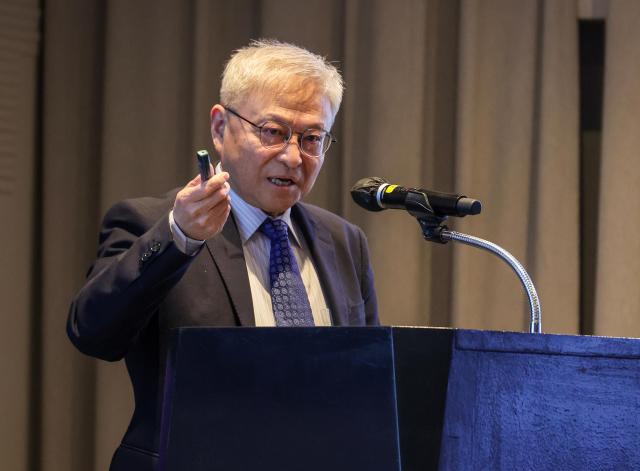
SEOUL, May 06 (AJP) - Iran will likely dominate the backdrop of next week’s summit between U.S. President Donald Trump and Chinese President Xi Jinping, but the two leaders are unlikely to produce any coordinated strategy on the Strait of Hormuz crisis as the world drifts deeper into a fragmented “G0 order,” according to prominent Chinese international relations scholar Yan Xuetong.
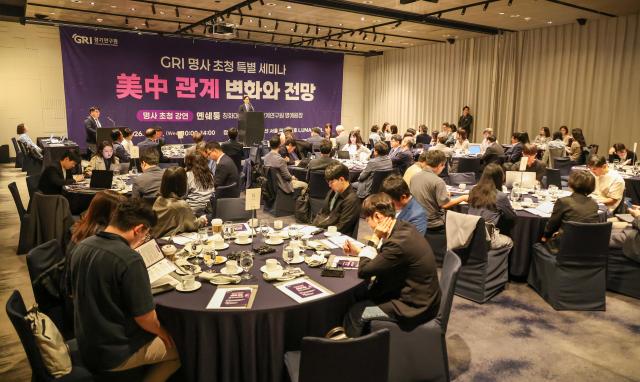
Yan, speaking Wednesday at a seminar titled “Changes and Prospects in U.S.-China Relations” hosted by the Gyeonggi Research Institute in Seongnam, argued that Trump and Xi are more likely to focus on trade and economic tensions than on resolving security flashpoints in the Middle East.
“As the Trump administration abandons global leadership, the world is entering a G0 order in which no country is willing or able to exercise clear global leadership,” Yan said.
The scholar said the center of global rivalry has fundamentally shifted away from ideology and territorial disputes toward technology, data and artificial intelligence. Rather than a revival of the Cold War, he described current U.S.-China tensions as a strategic competition over semiconductors, AI infrastructure, cloud computing and digital ecosystems.
“Cyberspace is becoming more important than natural space in both economic and security terms,” Yan said, pointing to the war in Ukraine as evidence that digital infrastructure and technological superiority can outweigh traditional geopolitical advantages.
He said the escalating Hormuz crisis reflects how military power, energy security, satellite navigation systems and digital targeting technologies have become increasingly intertwined. According to Yan, many of the technologies used by Iran in recent military operations are linked more closely to Chinese systems than to U.S. infrastructure.
Yan argued that AI is rapidly becoming a core strategic asset tied to economic productivity, industrial policy, military operations and national security. Both Washington and Beijing, he said, are increasingly moving toward self-contained technology ecosystems and domestic data governance structures, deepening fragmentation across global supply chains.
He identified electricity, rare earth minerals and skilled engineers as the three critical foundations for AI competitiveness. Europe, he said, has struggled to keep pace partly because of insufficient power generation capacity, while the United States is already facing rising electricity demand and localized supply pressures linked to AI data centers. China, by contrast, is preparing 33 nuclear power plants to support future AI-driven electricity demand.
For South Korea, Yan warned that the geopolitical balancing act will become increasingly difficult. While Seoul’s security structure remains anchored to the United States, its economy remains deeply intertwined with China. As semiconductors, batteries, AI and strategic technologies become more politicized, he said, South Korea will face growing pressure to make choices that blur the traditional divide between security and economics.
Yan also suggested that Trump’s “America First” approach could accelerate strategic uncertainty across East Asia if U.S. allies begin questioning Washington’s long-term reliability. At the same time, he argued that the region is unlikely to split cleanly into rival blocs, as many countries continue pursuing a hedging strategy that combines U.S. security ties, Chinese economic links and flexible diplomacy.
Taiwan is expected to remain another sensitive issue at the summit. Yan said both Washington and Beijing understand that destabilization across the Taiwan Strait or the broader Indo-Pacific would sharply raise risks for both sides, even as tensions continue to rise following recent U.S. arms sales to Taiwan.
Yan concluded that the coming decade will likely be defined by uncertainty, fragmented markets and increasingly politicized technology systems. Supply chains, technology standards and cross-border data flows, he said, will be shaped less by economic efficiency and more by national security calculations.
He also warned that while AI will intensify competition between the United States and China, it will simultaneously create shared global risks involving unemployment, overproduction, trade disputes, military misuse of AI and the absence of internationally coordinated governance standards.
Copyright ⓒ Aju Press All rights reserved.
