
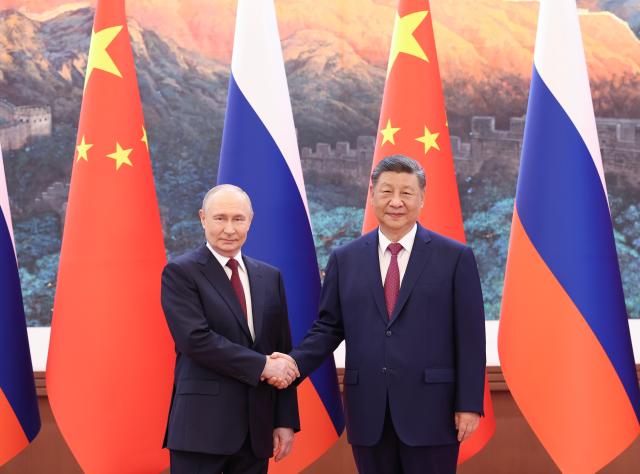
Beijing in May 2026 was no ordinary capital city. It had become a vast reception chamber where the currents of global power intersected and collided — a strategic stage upon which the outlines of a new international order were being tested.
Within days, U.S. President Donald Trump and Russian President Vladimir Putin arrived in Beijing in succession. European leaders intensified contacts with China. Middle Eastern rulers and Central Asian heads of state also gravitated toward Beijing. The world, unmistakably, was turning eastward once again.
This was not merely a sequence of diplomatic events. It was a historical signal — evidence that the world order forged over centuries since the Industrial Revolution is beginning to shift direction.
For generations, London stood at the center of the world economy. Later, New York and Washington became the twin pillars of finance, military power, industry, and modern civilization itself. Yet as the mid-21st century approaches, the geopolitical and economic center of gravity is moving again — toward the Pacific Rim and the far eastern edge of Eurasia: Northeast Asia.
At the center of that transformation stands China.
China is now the world’s largest manufacturing nation, its largest exporter, and one of its biggest importers of crude oil. Its influence stretches across electric vehicles, batteries, rare earths, solar energy, drones, artificial intelligence infrastructure, and global supply chains. The reason world leaders continue to arrive in Beijing is ultimately simple: no major question involving energy, trade, manufacturing, logistics, or investment can now be addressed without China.
The defining diplomatic image of May came immediately after Trump’s Beijing visit, when Putin arrived shortly thereafter. The spectacle of the leaders of the United States and Russia — the world’s two greatest military powers — traveling to Beijing in succession symbolized the transformation now underway in international politics.
Chinese President Xi Jinping has constructed a layered and highly disciplined diplomatic strategy. With the United States, China competes fiercely while carefully managing the relationship to avoid outright rupture. With Russia, Beijing deepens strategic coordination without surrendering autonomy. China confronts Washington over tariffs, semiconductors, Taiwan, and artificial-intelligence supremacy, yet still seeks to preserve economic interdependence. At the same time, it expands energy, financial, and security cooperation with Moscow to counterbalance the U.S.-led order.
What is emerging is, in effect, a “New Beijing System.”
The war in Ukraine has accelerated this transformation. As Russia lost much of the European market under Western sanctions, it moved rapidly into China’s economic orbit. Russian oil and gas increasingly flow eastward. Settlement in yuan has expanded sharply. The “Power of Siberia” pipeline project is more than an energy venture; it is a geopolitical artery binding Russia and China into a new Eurasian economic axis.
Yet beneath this partnership lies a quieter reality: Russia’s structural weakening.
Putin still projects the image of a formidable strongman, but the prolonged war in Ukraine has steadily drained Russian national power. Population decline, industrial stagnation, sanctions, and technological isolation have undermined Moscow’s long-term capacity — particularly in the Russian Far East.
Vladivostok, Khabarovsk, and Sakhalin increasingly appear less connected to Europe than to the economies of Northeast Asia. Chinese capital, logistics networks, manufacturing chains, and consumer markets have penetrated deeply into the region. Formally Russian territory, these areas are, economically speaking, becoming extensions of the broader Northeast Asian production system.
In many respects, Russia’s Far East no longer resembles the frontier of a resurgent empire. It increasingly resembles the outer periphery of a China-centered economic sphere.
The Middle East reveals a similar pattern.
Iran, Saudi Arabia, and the United Arab Emirates now regard China as an indispensable customer. The United States still dominates the region militarily, but China has begun exercising influence through purchasing power rather than aircraft carriers.
Iran, isolated by sanctions and geopolitical confrontation, has become increasingly dependent on Chinese demand for its oil exports. Russia faces a comparable predicament. With access to Western markets shrinking, Moscow has little choice but to lean on China’s vast consumer economy.
This marks a profound transformation in the nature of global power itself.
For decades, the United States shaped the world’s energy order through the dollar and naval supremacy. China, by contrast, is shaping geopolitics through market gravity. As the world’s largest manufacturing power and one of its largest consumer economies, China exerts strategic influence simply by buying.
And it is precisely at this moment that the strategic significance of South Korea and Japan rises once more.
In Northeast Asia, only Korea and Japan possess the economic and technological weight capable of balancing China. Japan retains world-class strengths in materials, components, precision engineering, and finance. South Korea commands leadership in semiconductors, batteries, AI servers, shipbuilding, and cultural industries.
Should Seoul and Tokyo move beyond historical antagonism and deepen strategic cooperation, a new equilibrium could emerge in Northeast Asia.
Washington clearly hopes for such an outcome. The United States alone cannot indefinitely bear the economic and strategic burden of containing China. Expanded Korea-Japan cooperation across supply chains, artificial intelligence, aerospace, nuclear energy, defense industries, and biotechnology could create a powerful new axis in the Indo-Pacific.
The AI era, in particular, presents fresh opportunities for both nations. While China advances through sheer scale and speed, Korea and Japan possess advantages in ultra-precision manufacturing, advanced semiconductors, robotics, and high-end industrial technology.
The concentration of industrial and technological power in Northeast Asia is no coincidence.
Before the Industrial Revolution, Asia stood at the center of the global economy. China and India accounted for enormous shares of world GDP. The Silk Road and maritime trade routes flowed through Asian civilization. Only after Britain’s industrial ascent did global dominance migrate westward toward Europe and eventually the United States.
Now the historical tide is turning again.
China is the world’s manufacturing giant. South Korea is the global leader in advanced memory semiconductors. Japan remains a superpower in precision manufacturing and robotics. The strategic heart of the global AI, semiconductor, and industrial supply chain system is increasingly converging in Northeast Asia.
History does not move in straight lines. It moves in cycles.
The center of world power that shifted westward after the Industrial Revolution is gradually returning eastward once again.
Yet the emerging order is anything but simple.
The United States remains the world’s dominant military and financial power. China commands manufacturing capacity, supply chains, and market scale. Russia, though weakened, still possesses nuclear weapons and immense natural resources. Europe, despite economic stagnation, retains formidable technological and financial depth.
In this increasingly complex geopolitical environment, South Korea can no longer survive through the traditional diplomacy of a middle power alone.
Korea must begin to view itself differently — as a strategic nation possessing critical leverage in semiconductors, AI, batteries, shipbuilding, nuclear power, and cultural influence. At the same time, Seoul must broaden its strategic partnerships with emerging powers such as India, Brazil, Saudi Arabia, the UAE, and Türkiye.
India is poised to become the world’s largest population center and a major AI and technology power. Brazil remains a resource and agricultural giant. Türkiye occupies a vital geopolitical crossroads connecting Europe, the Middle East, and Central Asia. Saudi Arabia and the UAE are rapidly repositioning themselves through investments in AI, smart cities, hydrogen economies, and advanced infrastructure.
The world is no longer moving toward a simple U.S.-China bipolar structure. It is evolving toward a multipolar order.
And at the center of that transformation lies Northeast Asia.
Seoul, Tokyo, and Beijing are emerging as the critical theaters of future economic, technological, and geopolitical competition.
May 2026 in Beijing was heated not merely by diplomacy, but by the deeper currents of history itself.
And now the world is watching another possible development: Xi Jinping’s potential visit to Pyongyang.
As North Korea and Russia deepen military and strategic ties in the wake of the Ukraine war, Beijing is unlikely to tolerate Pyongyang drifting too far into Moscow’s orbit. For China, North Korea is not simply a neighboring state. It is a strategic buffer bordering the American alliance system and a central pillar of Beijing’s influence in Northeast Asia.
A future visit by Xi to Pyongyang would therefore carry significance far beyond ceremonial diplomacy. It would signal that Beijing still intends to shape the Korean Peninsula’s strategic direction and draw North Korea back firmly within China’s geopolitical sphere.
Ultimately, all the scenes unfolding in Beijing converge into a single historical question:
What kind of order will define the Asian century of the 21st century?
And amid this vast civilizational transition, what kind of nation will Korea choose to become?
Copyright ⓒ Aju Press All rights reserved.
