
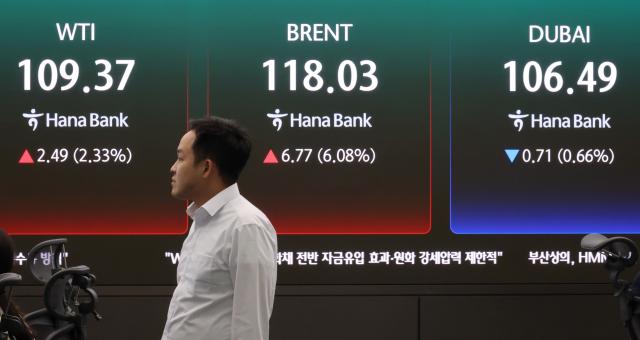
Industry officials said Tuesday that global crude inventories released to limit price spikes after the war began are increasingly being depleted, fueling concerns that international oil prices could surge above $150 a barrel as early as late this month. Energy-intensive sectors such as semiconductors, autos and petrochemicals would face sharply higher costs.
Semiconductor manufacturing requires massive electricity to run 24-hour clean rooms and lithography equipment. Industry officials said annual power costs to operate a single chip plant run into the trillions of won. With multiple plants operating at once, even a modest rise in electricity rates can directly hit earnings.
Airlines are on high alert as fuel bills climb, leaving carriers in a position where more flying can mean bigger losses. Fuel accounts for more than 30% of total airline spending. Korean Air said a $1 increase in oil prices adds $30.5 million (about 45 billion won) in annual costs.
Domestic fuel surcharges on air tickets moved in May to the highest level, stage 33, for the first time since the current system was introduced in 2016.
Korean Air said the one-way fuel surcharge on its Incheon-to-New York route jumped to 564,000 won in May from 76,500 won in February, rising more than sevenfold in three months and nearly doubling from the previous month. Asiana Airlines is also charging fuel surcharges of up to 476,200 won per one-way international ticket.
Automakers and defense-related manufacturers are also watching closely as higher energy costs threaten to raise production costs. While the impact has not been as immediate as in aviation, an ultra-high oil environment would likely increase industrial electricity rates and logistics costs. Automakers, already facing higher oil prices and weaker consumer sentiment, have complained that "there’s nothing left even if we sell."
Petrochemical companies are also bracing for the risk that the high-price trend worsens. After the war began, firms struggled to secure key inputs such as crude and naphtha, but they managed to defend results with expanded government support and improved margins. If oil prices surge again, those buffers could prove ineffective. With global oversupply, companies may find it difficult to pass a sudden rise in feedstock costs on to product prices, raising the risk of another profitability slump.
Calls are growing for the government and companies to step up efforts to stabilize energy supply chains. Some argue that until postwar supply shortages ease, authorities should use every available measure — including maintaining fuel tax cuts and releasing strategic stockpiles — to reduce corporate cost burdens.
Cho Hong-jong, a professor of economics at Dankook University, said high oil prices are likely to persist for a considerable period even if the war ends, citing geopolitical risks around the Strait of Hormuz. He urged securing crude supplies in advance by mobilizing global supply networks and, if necessary, seeking cooperation with countries such as Russia to help stabilize energy prices.
* This article has been translated by AI.
Copyright ⓒ Aju Press All rights reserved.