
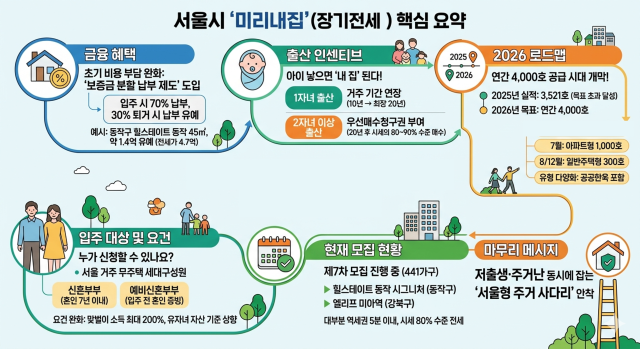
As high prices and rental shortages strain newlyweds, demand for Seoul's long-term rental housing program, 'Mirinae House,' is surging. The initiative allows for partial deposit payments, easing financial burdens and increasing accessibility to private brand apartments.
From May 6 to 8, the Seoul Metropolitan Government and the Seoul Housing and Communities Corporation (SH) are recruiting residents for the seventh round of 'Mirinae House' (Long-term Rental Housing II), offering 441 units. This program targets newlyweds planning to have children, providing extended residency and home purchase opportunities for families that give birth after moving in.
A notable feature of this recruitment is the 'deposit installment payment system.' Tenants can move in by paying only 70% of the rental deposit, deferring the remaining 30% until they vacate.
For instance, in the Dongjak District's Hillstate Dongjak Signature, a 45-square-meter unit with a rental price of 469.56 million won requires an initial payment of 328.69 million won, with the remaining 140.86 million won deferred until departure. This translates to an annual interest burden of about 5.63 million won, or approximately 470,000 won monthly, based on a 4.0% interest rate.
A Seoul official stated, "Due to loan restrictions and rising rental prices, many newlyweds have faced increased initial costs, leading to canceled applications or contracts. We introduced the deposit installment system to alleviate this burden."
Previously, Seoul Mayor Oh Se-hoon noted that competition for 'Mirinae House' had decreased due to lending restrictions and suggested easing these regulations for young people.
This supply focuses on popular private brand apartments, including Hillstate Dongjak Signature, Boramae Station Precinct, and nearby complexes in Gangbuk District. Major brands like Raemian and Xi are also included, with most located within a five-minute walk from subway stations and rental prices set at about 80% of the market rate.
Eligible applicants are households residing in Seoul without property as of the announcement date. Newlyweds must be within seven years of marriage, while prospective couples must provide proof of marriage before moving in. The income limit for dual-income households has been raised to 200% of the average monthly income for urban workers, and asset limits for families with children have also been increased.
Benefits for families with children remain intact. Households with one child can reside for up to 20 years, while those with two or more children will have the right of first refusal to purchase the unit at the end of their residency. A Seoul official explained, "The right of first refusal will be based on approximately 80-90% of the market price after 20 years."
These conditions align with current rental market trends, driving demand amid limited supply. Competition remains high, with application ratios for the first three rounds of 2024 at 59.8 to 1, 50.0 to 1, and 38.0 to 1, respectively. Last year's rounds recorded ratios of 64.8 to 1, 39.7 to 1, and 69.7 to 1, with the highest competition reaching 759 to 1 for a 59-square-meter unit in Guro District during the fourth round.
Seoul plans to expand the annual supply of 'Mirinae House' to 4,000 units this year. Following this offering of over 440 units, an additional 1,000 units will be announced in July, along with approximately 300 general housing units in villa and officetel formats later in the year.
* This article has been translated by AI.
Copyright ⓒ Aju Press All rights reserved.