
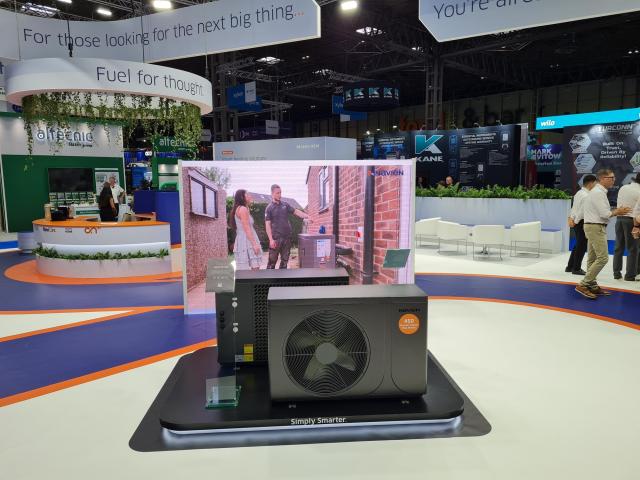
The government's policy to promote eco-friendly heat pumps is intensifying competition in the home heating market between major corporations and specialized boiler companies.
As of May 7, the boiler industry reports that Samsung Electronics and LG Electronics are leveraging their advanced smart appliance ecosystems and high-efficiency technologies to penetrate the domestic heat pump market. In response, traditional boiler manufacturers like Kyungdong Navien and Kiturami are emphasizing their ultra-eco-friendly refrigerant technologies and exclusive installation infrastructures.
Heat pumps are eco-friendly products that provide heating and hot water by utilizing heat from the air, operating similarly to refrigerators and air conditioners. They absorb heat from the air and convert it into high-temperature heat through a compressor, offering high energy efficiency without harmful emissions from fossil fuels.
The government aims to install 3.5 million heat pumps by 2035 as part of its 2050 carbon neutrality goal. Given that the installation cost per household exceeds 10 million won, the domestic heat pump market is projected to grow to over 35 trillion won in the next decade.
With major companies entering the heat pump market, competition is heating up. Last month, Samsung launched its Korean-style EHS heat pump boiler, which uses an air-to-water method to absorb heat from the outside air. It achieved a seasonal performance factor (SCOP) of 4.9 under floor heating conditions at 35°C, demonstrating energy efficiency by supplying nearly five times the heat energy compared to the electricity consumed.
LG also introduced a new integrated heat pump system this month, designed with a structure that combines the outdoor unit and key components, allowing for easy installation without separate refrigerant piping.
Traditional boiler manufacturers believe their eco-friendly technologies and extensive service networks will serve as barriers against the advances of large corporations. Refrigerant choice is also a key differentiator.
Samsung and LG's heat pumps use the semi-eco-friendly refrigerant R32, which reduces carbon dioxide emissions compared to previous generations but has a global warming potential (GWP) of 675, falling short of the natural refrigerants that meet global environmental standards.
In contrast, Kyungdong Navien is targeting the market with the next-generation natural refrigerant R290, which has a GWP of just 3, fully complying with global carbon regulations.
Kiturami's Century, a subsidiary specializing in refrigeration and air conditioning, is expanding into the commercial market with R32-based inverter scroll heat pumps. They plan to distribute these systems to public facilities, agricultural sites, and commercial buildings.
The decades-long expertise in specialized installation and service networks is also seen as a strong asset for traditional boiler companies. An industry insider noted, "Heat pump boilers require precise installation tailored to existing plumbing designs, pressure balance, and insulation conditions. Poor installation can lead to significant heating efficiency drops or safety issues like freezing and leaks in winter."
* This article has been translated by AI.
Copyright ⓒ Aju Press All rights reserved.