
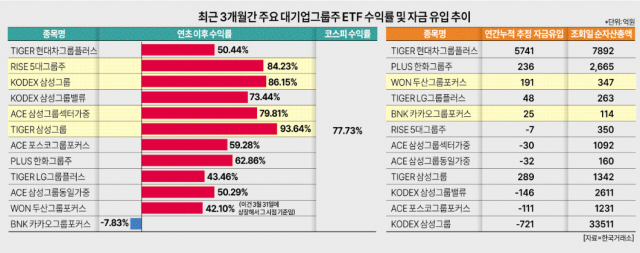
In the ongoing rally toward the "dream 7000-point" mark, Samsung Group has solidified its dominance in the domestic exchange-traded fund (ETF) market, achieving over 93% returns since the beginning of the year. In contrast, major companies like Hyundai and LG have underperformed, contributing to a growing disparity in returns.
According to the Korea Exchange, as of May 7, ETFs tracking major conglomerates (excluding bonds) have shown that Samsung-related products dominate the top returns.
The standout performer is the 'TIGER Samsung Group' ETF, which has achieved a remarkable 93.64% return. Following closely are 'KODEX Samsung Group' at 86.15% and 'RISE 5 Major Groups' at 84.23%, which has a high concentration of semiconductor stocks like Samsung Electronics and SK Hynix. The 'ACE Samsung Group Sector Weighted' ETF also recorded a solid 79.81% return.
This surge in ETF performance is largely attributed to Samsung Electronics' significant rise, driven by the AI semiconductor supercycle. The KOSPI index has increased by 77.73% during the same period, but Samsung-related ETFs have outperformed by 10-15 percentage points, with Samsung Electronics soaring by 126.44%.
In contrast, the returns for the other five major groups have lagged behind the KOSPI. The 'TIGER LG Group Plus' ETF showed the weakest performance at 43.46%, followed by 'TIGER Hyundai Group Plus' at 50.44% and 'ACE POSCO Group Focus' at 59.28%. Even the 'PLUS Hanwha Group' ETF, which benefited from strong shipbuilding and defense sectors, could only manage 62.86%, falling short of the KOSPI's gains.
Among other large corporate groups, the disparity in returns is even more pronounced. The 'WON Doosan Group Focus,' launched on March 31, has achieved a 42.10% return, exceeding the KOSPI's 41.93%. However, the 'BNK Kakao Group Focus' has reported a -7.83% return, the only major group ETF in negative territory.
This divergence in returns has led to polarized capital flows. Notably, the 'TIGER Hyundai Group Plus,' which underperformed, attracted a substantial inflow of 574.1 billion won, likely due to investor optimism regarding Hyundai's value-up program and new business ventures in robotics. Conversely, the high-performing 'KODEX Samsung Group' saw an outflow of 72.1 billion won as investors took profits, believing the index had peaked.
Kim Seong-no, a researcher at BNK Investment & Securities, noted, "While the expansion of the ETF market has created favorable supply conditions, ongoing macroeconomic uncertainties could amplify stock market volatility. Given the concerns over slowing growth amid the index's rise, investors should be prepared for potential technical corrections due to overheating."
* This article has been translated by AI.
Copyright ⓒ Aju Press All rights reserved.